
If you’ve lived in the Triangle for more than a summer, you already know the air feels different here. Hardwood floors that gap in winter and swell in summer. Musty smells that appear out of nowhere. Condensation on windows even when the AC is running. These aren’t random occurrences — they’re predictable outcomes of where you live and how your home was built.
Raleigh has a humidity problem — and most homes in Wake County were built in a way that amplifies it.
Raleigh’s Climate Creates Constant Moisture Pressure
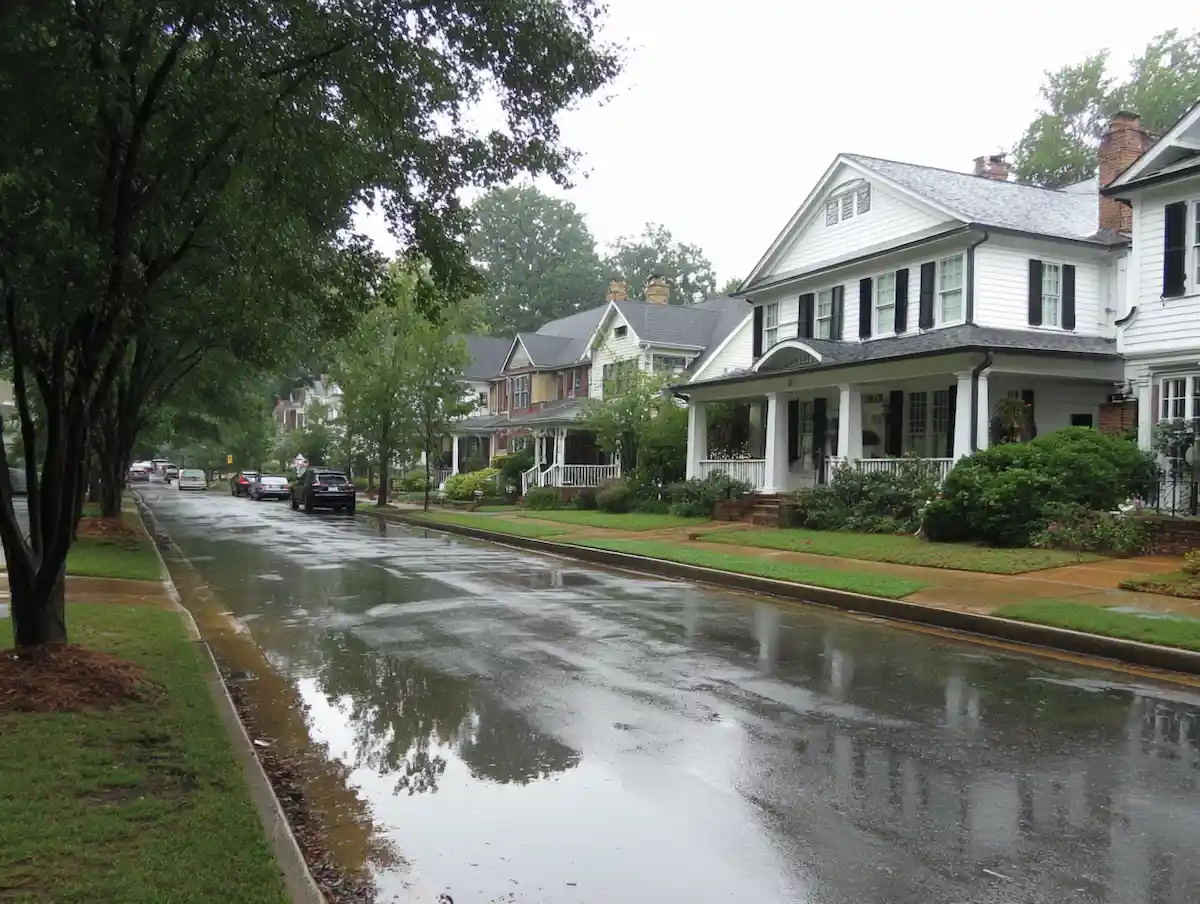
Raleigh sits in a humid subtropical climate zone — the same classification as Atlanta, Houston, and coastal South Carolina. That means hot, wet summers with very little relief.
From May through September, outdoor relative humidity in Raleigh averages between 73% and 78%, peaking in August. The city receives about 46 inches of rain per year, well above the national average of 38 inches. And unlike coastal areas where sea breezes offer some relief, the Triangle sits inland — moisture builds and stays.
What this means for your home: the outdoor air pushing in through every vent, gap, and opening is loaded with moisture for five to six months of the year. Your home’s envelope is under constant humidity pressure whether you notice it or not.
Your air conditioner helps, but it was designed primarily to cool — not to dehumidify. An AC unit cycles on and off based on temperature. On mild summer days when the temperature doesn’t trigger the unit to run long, humidity climbs even though the thermostat reads fine. A Whole-House dehumidifier works independently of your AC to maintain target humidity regardless of temperature.
Crawl Space Construction in Wake County Homes
Vented crawl space construction is common throughout Wake County homes built between 1985–2015.
The majority of homes in Raleigh, Cary, Holly Springs, Apex, and Fuquay-Varina were built with vented crawl spaces. Foundation vents were required by older building codes under the logic that outdoor air would naturally dry out the space beneath your home.
In dry climates, that logic holds. In North Carolina, it creates the problem it was meant to prevent.
During summer, warm humid outdoor air enters your crawl space through the foundation vents. When that moist air contacts the cooler surfaces inside — concrete block, soil, wood framing — it hits the dew point and condenses. Moisture settles on your subfloor, joists, and rim board. Insulation absorbs water and loses its effectiveness. Over time, conditions become ideal for mold growth and wood deterioration.
Building science has caught up with this reality. North Carolina’s current building code actually requires mechanical drying capability — typically a dehumidifier — in closed crawl spaces. The state recognized that passive ventilation doesn’t work in a humid subtropical climate.
If your home has open foundation vents, they are likely making your crawl space wetter, not drier. A properly sealed and encapsulated crawl space combined with a properly sized crawl space dehumidifier is the code-compliant, building-science-backed solution.
Wake County’s Clay Soil Adds Ground Moisture Year-Round

The red clay soil common throughout the Triangle isn’t just hard to dig — it’s a chronic moisture source beneath your home.
Clay retains significantly more water than sandy or loamy soils. After rain, it drains slowly, holding moisture against your foundation walls for days. That moisture doesn’t just sit there — it migrates. Ground vapor rises continuously from the soil beneath your crawl space, moving upward through exposed dirt and into the air space below your home.
This happens in every season. Even during a dry stretch in January, the clay beneath your crawl space is releasing moisture. Without a properly sealed vapor barrier and active humidity control, that ground moisture accumulates in your framing, insulation, and subfloor throughout the year.
Why Hardwood Floors Buckle in Raleigh
Wood is hygroscopic — it absorbs and releases moisture based on the surrounding air. In a home with crawl space humidity problems, that moisture travels upward through the subfloor and into your hardwood.
In summer, boards absorb moisture and swell. You may see cupping (edges higher than the center of each board), crowning, or buckling. In winter when the air dries out, the same boards shrink and gaps open between planks. This seasonal movement happens gradually, and many homeowners assume it’s just how hardwood floors behave in the South.
It’s not inevitable — it’s a symptom of uncontrolled humidity. If your floors are moving, the crawl space is almost always the underlying cause. See 5 Signs Your Home Has a Humidity Problem for other symptoms to watch for.
Why Your HVAC System Can’t Fix It Alone
Your HVAC system was designed to control temperature — not humidity. It removes some moisture as a byproduct of cooling, but only when it’s actually running.
On a mild summer day — 74°F outside, 71°F inside — the AC may barely run. Meanwhile, outdoor humidity is 80% and moisture is moving freely into your crawl space and living areas. The crawl space compounds this because it is typically not conditioned by your HVAC at all. The space beneath your home sits at its own temperature and humidity level, independent of what your thermostat is doing.
Even if your living areas feel comfortable, your crawl space may be sitting at 80% relative humidity or higher all summer — silently feeding mold growth and wood moisture you can’t see. A dedicated whole-house dehumidifier integrated with your HVAC closes that gap. A crawl space unit addresses the source directly.
What Proper Humidity Control Looks Like
The target is 45–50% relative humidity throughout your home year-round. At that range, mold cannot sustain growth, wood remains dimensionally stable, and indoor air quality is healthy.
During inspections, we commonly measure crawl space humidity above 70% in summer months — even when indoor temperatures feel comfortable. The living areas read fine on the thermostat while the space beneath the home is actively creating conditions for mold and wood damage.
Achieving proper control in a Raleigh home typically means:
- Sealing crawl space vents to stop warm humid outdoor air from entering
- Installing a vapor barrier to block ground moisture rising from clay soil
- Installing a properly sized crawl space dehumidifier to maintain target RH
- Adding Whole-House dehumidification if living-area humidity remains elevated after the crawl space is controlled
The right approach depends on your home’s construction, crawl space size, existing vapor barrier, and measured humidity levels. That’s why we always start with an inspection — not a sales pitch.
Start With a Crawl Space Inspection
If your home was built with a vented crawl space and you're noticing musty odors, condensation, or floor movement, humidity is almost certainly the underlying issue. The good news: it's a solvable problem with the right system in place.
We inspect crawl spaces and measure Whole-House humidity conditions across Raleigh, Cary, Apex, Holly Springs, and Fuquay-Varina.
Straight answers. Clear measurements. A practical plan to fix it.