ERV Installation in Raleigh, NC for Fresh-Air Ventilation
Professional ERV installation designed for Wake County's humid climate and modern tight homes.An ERV (Energy Recovery Ventilator) brings fresh outdoor air into your home while transferring heat and moisture between the incoming and outgoing air streams. That improves indoor air quality without driving up humidity or energy costs.
Why ERV Installation Matters in This Area
In Wake County's humid climate, outdoor air can raise indoor Relative Humidity (RH) if introduced without control.An ERV transfers heat and some moisture between air streams, helping temper incoming air before it enters the home. That makes balanced fresh-air ventilation in the Triangle region very different from just opening a window or adding an intake fan.
ERVs improve ventilation and energy performance, but because humid outdoor air can still raise indoor moisture, they are often paired with Whole-House dehumidification systems for balanced comfort and stable RH control.
What an ERV Does
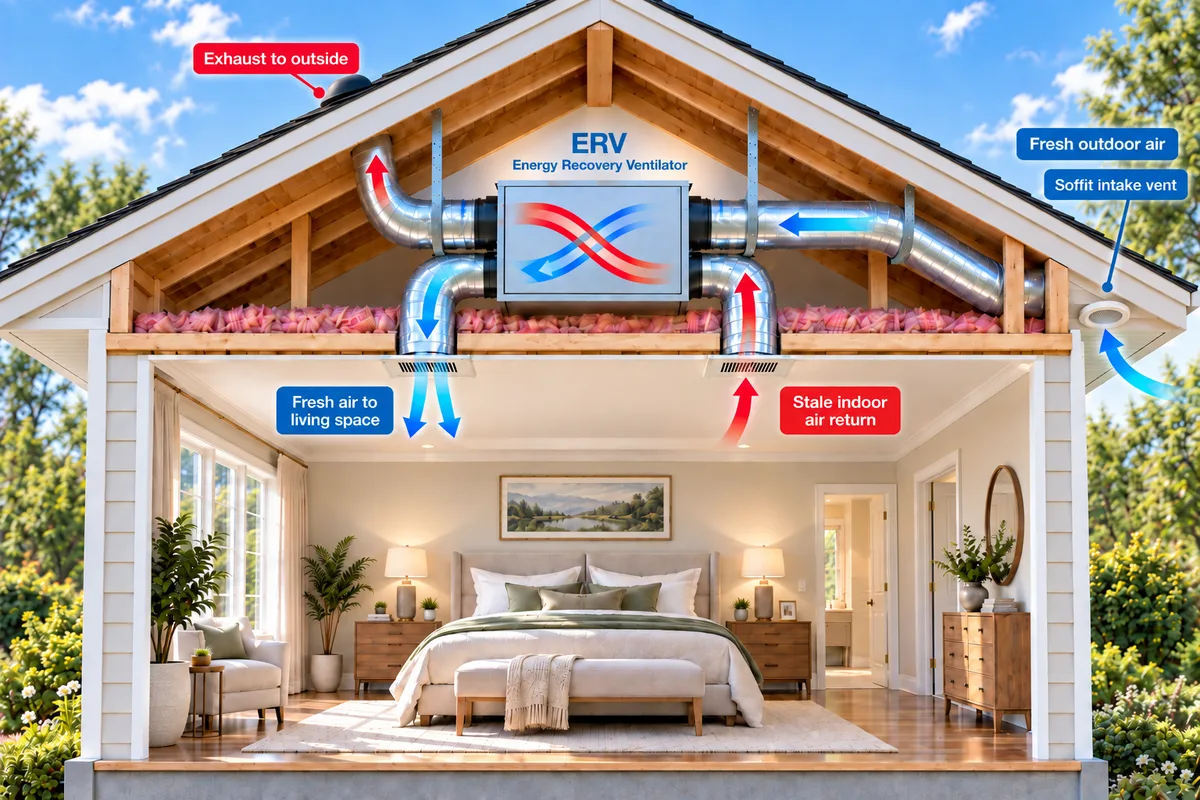
An ERV provides balanced fresh-air ventilation while transferring heat and moisture between the incoming and outgoing air. The result is better indoor air quality without a spike in humidity.In tight homes, ventilation matters. An ERV helps control stale air, odors, and indoor pollutants without the "open a window" approach that can drive humidity to damaging levels during North Carolina summers.
As a whole-house ventilation system, an ERV provides balanced ventilation. It exhausts stale indoor air while bringing in filtered outdoor air at the same rate, which keeps the pressure inside the home neutral.
What an ERV Removes From Your Indoor Air
An ERV continuously dilutes the pollutants that build up in tight, sealed homes, including carbon dioxide, VOCs, formaldehyde, and household odors, by replacing stale indoor air with a controlled stream of fresh outdoor air.The EPA notes that indoor air can be two to five times more polluted than outdoor air. In a Triangle home running the AC with windows closed from May through September, the same air recirculates through a sealed envelope for months. Here's what builds up, and how an ERV handles each one:
Carbon Dioxide (CO2)
Outdoor air runs about 420 ppm. A well-ventilated home stays between 600–800 ppm, but tightly built Triangle homes routinely exceed 1,000 ppm in occupied bedrooms overnight. That's enough to cause stuffiness, fatigue, and disrupted sleep. An ERV running continuously dilutes CO2 with fresh outside air around the clock.
VOCs & Formaldehyde
Flooring, cabinets, paint, and furniture off-gas VOCs and formaldehyde. This is heaviest in the first few years after construction, and NC's heat and humidity speed it up. Fresh-air ventilation dilutes these emissions directly, and holding 45–50% RH slows the off-gassing rate.
Odors & Stale Air
Cooking, pets, and everyday living leave odors that linger in homes with little air exchange. Continuous balanced ventilation clears them without the humidity penalty of opening a window.
Allergens & Particulates
An ERV brings filtered fresh air in, and a higher-MERV whole-house filter captures the fine particles a standard 1-inch filter misses, like pollen, dust, and PM2.5. The two work together for whole-home particle control.
Fresh-air rates follow ASHRAE Standard 62.2, which sets the minimum ventilation a home needs based on its square footage and number of occupants. We size every ERV to that standard. For the full breakdown of what's in your home's air, see our guide to indoor air quality for NC homes.
When an ERV Makes Sense
ERVs are most useful when the home is tight or when indoor air quality issues persist despite other measures.Newer or tighter homes with poor natural air exchange benefit most from controlled ventilation
Odors that linger, like cooking, pets, or musty smells, point to inadequate fresh air exchange
Condensation on windows or vents can signal humidity and ventilation imbalance
Homes adding Whole-House dehumidification benefit from ERV integration for stable RH and fresh air
Humidity and Ventilation in the Triangle Region
Fresh air ventilation improves indoor air quality, but if it's left unmanaged in a humid climate, it can raise indoor Relative Humidity (RH).Uncontrolled outdoor air can raise indoor RH above 60% in humid climates without proper design. Ventilation without humidity control creates the exact conditions where mold becomes active and comfort suffers.
In two-story homes, the stack effect can draw crawl space or basement air upward, making balanced ventilation and humidity control even more important. If your crawl space is also damp, that moisture compounds the problem through floor penetrations and HVAC pathways.
In many Raleigh homes, ERVs are paired with dedicated dehumidification systems to maintain stable 45–50% RH targets. ERV installation works best when humidity sources are controlled and indoor RH targets are realistic.
Do You Need an ERV, a Dehumidifier, or Both?
An ERV replaces stale indoor air with fresh outdoor air, while a dehumidifier removes excess moisture. They solve different problems, and most Raleigh homes need both for healthy indoor air year-round.ERV
- Exchanges indoor and outdoor air continuously and efficiently
- Transfers heat and some moisture between air streams
- Improves indoor air quality and reduces pollutants
- Typically does not directly control indoor RH in humid climates like Raleigh
Whole-House Dehumidifier
- Removes moisture directly from indoor air
- Maintains stable 45–50% RH year-round
- Controls humidity independent of ventilation
- Can be configured to introduce fresh outdoor air but does not exhaust stale indoor air
ERV vs. HRV: Which Is Right for a Triangle Home?
An HRV (heat recovery ventilator) transfers only heat between the outgoing and incoming airstreams. An ERV (energy recovery ventilator) transfers both heat and moisture. In a humid climate like Raleigh and Wake County, that moisture transfer is the deciding factor. It takes a little of the moisture out of incoming summer air, where an HRV would let all of it straight in. The effect is modest and it is not humidity control, but it is the right direction for this climate. For most Triangle homes we recommend an ERV over an HRV for that reason, though the right choice always depends on your home and HVAC system.
For Whole-House humidity control see our whole-house dehumidifier installation page. For crawl-space-specific humidity see our crawl space dehumidifier installation page.
How We Install and Commission ERVs
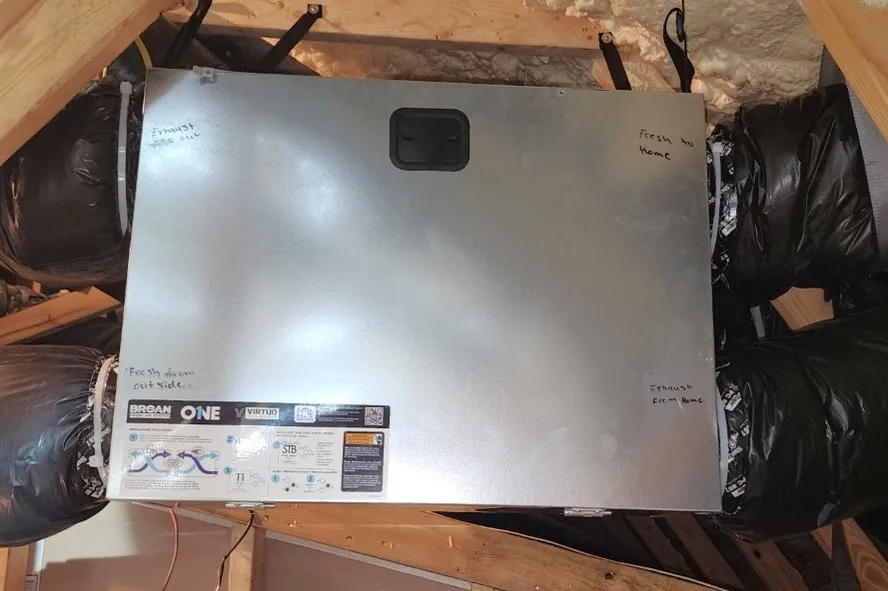
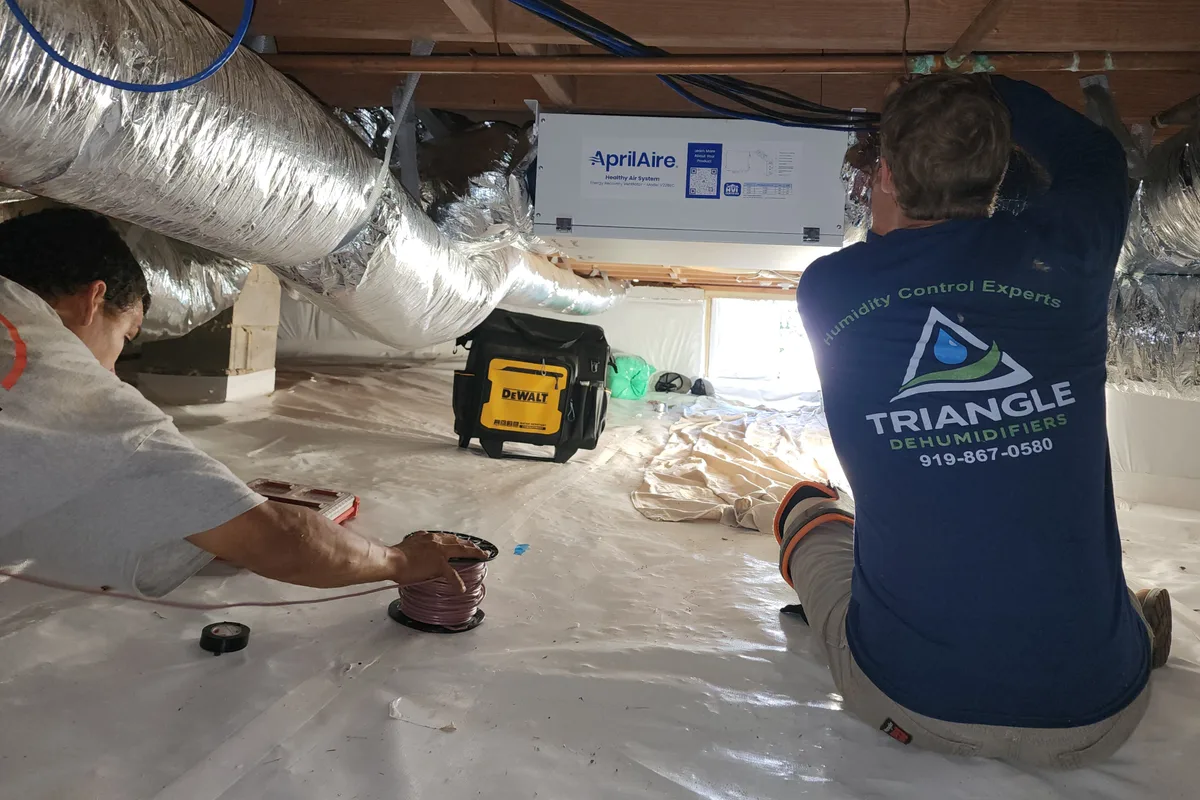
We size airflow, plan duct routes, and verify balanced performance, so the ERV actually does what it's supposed to do.Proper commissioning ensures balanced airflow, correct static pressure, and ventilation rates aligned with home size and occupancy. We verify these before completion.
Airflow Sizing
Proper ventilation rates based on your home's size and occupancy, not a one-size-fits-all number.
Duct Routing
Intake and exhaust locations planned to avoid short-circuiting and to prevent pulling air from attics or crawl spaces.
HVAC Integration
Standalone ducting or a proper tie-in to your existing HVAC, evaluated for your specific system.
Control Strategy
Timed ventilation, continuous low-speed operation, or integrated humidity control when paired with a dehumidifier. We pick the approach based on your home's needs.
Related Services
ERV installation works best as part of a complete humidity and ventilation strategy.Frequently Asked Questions
Will an ERV lower humidity?
An ERV reduces humidity load compared to straight outside-air ventilation, but it is not a dehumidifier. In most Triangle-area homes, dedicated dehumidification is still needed alongside an ERV.
Does an ERV replace a dehumidifier?
No. In humid climates like North Carolina, an ERV and a dedicated dehumidifier usually work together. The ERV handles fresh air, and the dehumidifier controls relative humidity. They do two different jobs.
Do I need an ERV or an HRV?
In humid climates, ERVs are generally preferred because they transfer some moisture between airstreams, helping temper incoming air. Final choice depends on the home, the HVAC system, and your specific goals.
Will an ERV make my house more humid?
In humid climates, unmanaged ventilation can increase indoor RH. Proper ERV design, sizing, and integration with a dehumidification strategy prevents this.
How much does ERV installation cost in Raleigh?
Most ERV installations in the Raleigh area run an estimated $5,000–$7,000, depending on duct routing, attic or crawl space access, existing HVAC configuration, and unit selection. An in-person evaluation is the best way to determine accurate pricing for your specific home.
How does an ERV improve indoor air quality in Raleigh, NC?
An ERV continuously replaces stale indoor air with fresh outdoor air while recovering energy from the exhaust stream. That lowers CO2 buildup, allergens, and household odors, and because it recovers heat from the exchange, it does so without a big jump in energy use. It also pulls a small amount of moisture out of incoming summer air, though indoor humidity control still comes from a dehumidifier.
What is a normal CO2 level in a home?
Outdoor air is about 420 ppm. A well-ventilated home typically runs 600–800 ppm, but tightly built Triangle homes often climb past 1,000 ppm in occupied bedrooms overnight. That is high enough to cause stuffiness and disrupt sleep. An ERV running continuously dilutes indoor CO2 with fresh outside air and keeps levels in a healthy range. For more, see our indoor air quality guide.
What indoor air pollutants does an ERV remove?
An ERV dilutes the pollutants that build up in sealed homes, including carbon dioxide, VOCs, formaldehyde, and household odors, by continuously exchanging stale indoor air for fresh outdoor air. For fine particles like PM2.5 and pollen, we pair the ERV with whole-house filtration. For moisture, we pair it with a dedicated dehumidifier.
How often do ERV filters need changing?
ERV filters typically need inspection every 3–6 months and replacement annually, depending on local air quality and usage. We design every installation with accessible filter locations to make routine maintenance straightforward.
Related Reading
Balanced Fresh Air Without Creating a Humidity Problem
Serving Raleigh, Cary, Apex, Holly Springs, Fuquay-Varina, and surrounding Wake County communities.
Schedule Fresh-Air & Humidity Evaluation Licensed & Insured. Locally Owned. Serving the Triangle region.