Encapsulated Crawl Space Dehumidifier Installation in Raleigh, NC
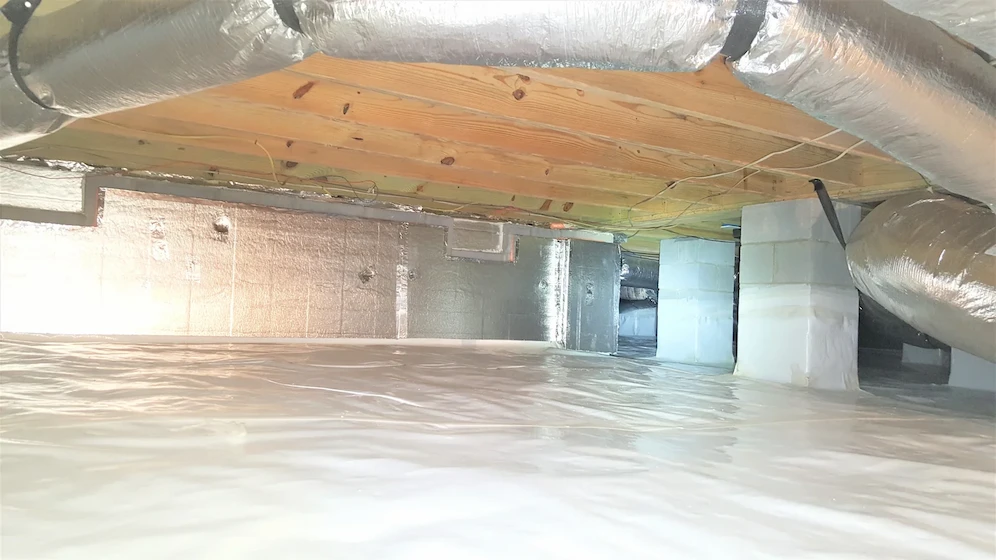
Encapsulation alone does not control humidity. We install properly sized dehumidifiers to maintain ~50% Relative Humidity (RH) inside sealed crawl spaces.Even professionally encapsulated crawl spaces in Raleigh can exceed 60% RH without active humidity removal. A sealed space can trap humidity unless it is mechanically removed.
We inspect, size, install, and verify humidity control performance.
Serving Raleigh, Holly Springs, Cary, Apex, Fuquay-Varina, and the surrounding Triangle region.
Do Encapsulated Crawl Spaces Still Need a Dehumidifier?
Yes. Encapsulation reduces moisture infiltration but does not remove humidity. A sealed crawl space requires active moisture control to maintain safe RH levels. A dehumidifier is the most effective solution.Encapsulation is an important first step — it reduces ground moisture intrusion and blocks soil vapor. But sealing the space does not regulate Relative Humidity. Moisture in the air still enters through foundation walls, seasonal air leakage, and diffusion through the liner itself.
In Raleigh's humid climate, summer exterior Relative Humidity (RH) often exceeds 80%, increasing moisture load even in sealed systems. Without a dehumidifier, that moisture load has nowhere to go — RH can build until condensation forms. Eventually, mold becomes active on wood framing, HVAC equipment and ductwork, even behind foundation insulation and under a clean vapor barrier.
Mold activates above 65% RH. The target range for a sealed crawl space is 45–50% Relative Humidity (RH) — maintained continuously by a properly sized dehumidifier.
Moisture can migrate through sections of concrete and block foundation walls regardless of encapsulation
NC summers regularly push exterior RH above 80% — sealed spaces absorb this load
Air movement caused by pressure differences and the stack effect pulls humid air into the crawl space. In a sealed system, that moisture has limited escape paths, allowing RH to gradually rise.
What Is the Ideal Relative Humidity (RH) for a Sealed Crawl Space?
Most encapsulated crawl spaces should be maintained between 45–50% Relative Humidity (RH) to reduce mold risk and protect wood framing.At 45–50% RH, mold cannot sustain growth on wood surfaces — even if spores are present. Mold growth risk increases rapidly above 65% RH, which is why we target a stable 45–50% range. This range also protects subflooring from moisture-related swelling, cupping, and delamination, and prevents condensation from forming on HVAC ductwork routed through the crawl space.
Long-term structural health depends on consistent humidity control. Wood framing held at safe moisture content levels resists decay, maintains dimensional stability, and avoids the conditions that lead to costly repairs.
How We Size Dehumidifiers for Encapsulated Crawl Spaces
Proper sizing is based on crawl space volume, moisture load, and air exchange — not square footage alone.Sealed crawl spaces behave differently than vented ones. Lower air exchange rates mean moisture accumulates more slowly — but also means a correctly sized unit is critical. Undersized units run continuously without reaching target RH. Oversized units short-cycle and waste energy.
We routinely work with 12-mil and 20-mil encapsulation systems and account for liner integrity when evaluating moisture load.
Calculate Crawl Space Volume
Square footage and ceiling height determine total air volume the system must control.
Assess Moisture Load
Foundation wall type, soil conditions, and vapor barrier quality — including 12-mil and 20-mil systems — affect total moisture contribution.
Consider Air Exchange Rate
Sealed systems have lower infiltration — we account for this when selecting unit capacity.
Install Continuous Drainage
No bucket systems. Dedicated drain line or condensate pump required for unattended operation.
Verify Target RH at 45–50%
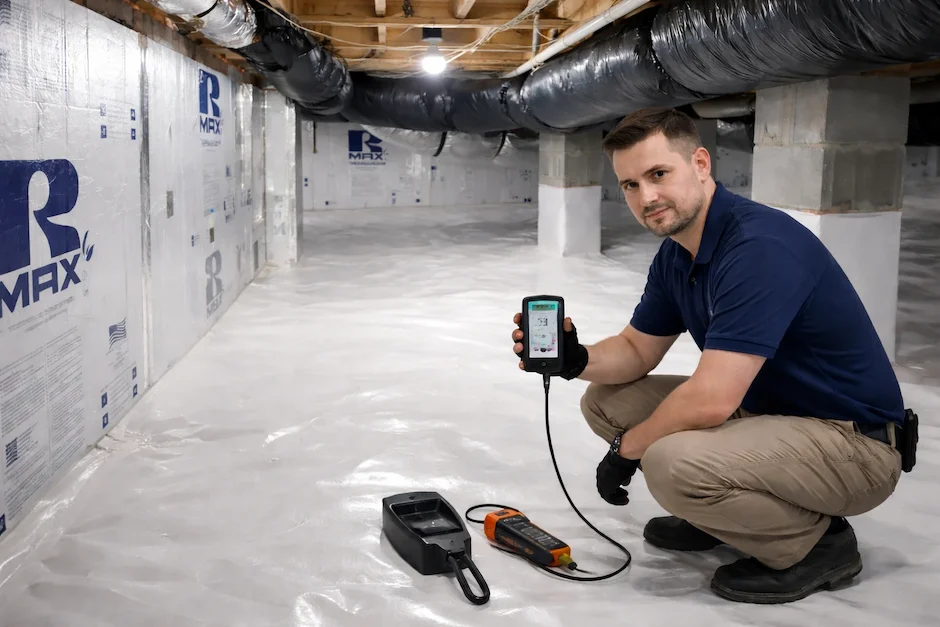
System tested and programmed before we leave. Digital hygrometer installed for ongoing monitoring.
Professional-Grade Equipment Designed for Sealed Crawl Spaces
We install crawl-space-rated systems built for sealed environments.Consumer units from home improvement stores require manual bucket emptying and are not rated for the low clearance and high humidity conditions typical of crawl spaces. We install commercial-grade units built specifically for sealed, low-clearance environments — calibrated to maintain 45–50% RH year-round.
Signs Your Encapsulated Crawl Space Has High Humidity
If RH rises above 60%, mold growth and moisture damage can begin — even in sealed crawl spaces.Musty odors inside — even with encapsulation in place
Condensation on ductwork, pipes, or structural members
Visible mold on floor joists or subfloor above the barrier
Warped or cupped subflooring above the crawl space
Elevated indoor humidity your HVAC cannot reduce
Dehumidifier running constantly or failing prematurely
Poor indoor air quality from airborne mold spores and particulates
Lower indoor comfort — rooms feel stuffy, clammy, or unusually warm
How Crawl Space Humidity Affects Indoor Air Quality and Home Comfort
High crawl space humidity doesn't stay in the crawl space — it moves into your living areas and directly impacts the air your family breathes.Through the Stack Effect, warm air rising inside your home pulls damp crawl space air upward through subfloor gaps, plumbing penetrations, and HVAC pathways. Even in an encapsulated crawl space, uncontrolled humidity becomes a Whole-House problem.
Elevated indoor relative humidity makes your home feel warmer than the thermostat reads, forces your HVAC to work harder, and creates conditions where allergens, dust mites, and mold thrive. In Raleigh's humid climate, shoulder seasons — spring and fall — are particularly problematic, as outdoor humidity regularly exceeds 70–80% RH.
High humidity makes your home feel sticky and warm even at correct thermostat settings
Your system works harder to cool humid air, raising energy bills and shortening equipment life
Mold spores, dust mites, and allergens thrive in humid conditions and circulate through your HVAC system
Maintaining 45–50% RH in your crawl space and home creates a measurably more comfortable living environment, reduces allergen activity, and allows your HVAC to operate efficiently year-round. Homeowners across Raleigh, Cary, Apex, and Wake County consistently report improved comfort after professional dehumidifier installation.
How Long Does a Dehumidifier Last in a Sealed Crawl Space?
A properly sized and properly drained crawl space dehumidifier typically lasts 7–10 years.Most premature failures come from three installation mistakes: undersizing, poor drainage, and lack of airflow design. Undersized units run continuously trying to reach target RH — burning out the compressor years ahead of schedule.
Bucket-based drainage is the most common failure point. When buckets fill and the unit shuts off, RH spikes. The unit cycles on and off under high load — exactly the conditions that shorten compressor life fastest.
A continuous drain line or condensate pump eliminates this problem entirely. Combined with correct sizing and proper airflow, your system should operate efficiently for 7–10 years with only routine maintenance.
Understanding the Stack Effect in Raleigh Homes
Warm air rising in your home pulls air upward from the crawl space, bringing moisture and odors into the living space.As warm air rises and exits through upper floors, it creates negative pressure at the base of the home. This pressure imbalance pulls crawl space air into the living space through subfloor gaps, plumbing penetrations, and HVAC pathways.
In Raleigh's humid climate, this means an uncontrolled crawl space directly affects the air quality and humidity of your living areas. HVAC returns located in the crawl space or lower floors can pull this moisture directly into your system.
Controlling crawl space humidity at the source — maintaining 45–50% RH — is the most effective way to prevent the Stack Effect from degrading your indoor environment.
Frequently Asked Questions
Do encapsulated crawl spaces need ventilation?
Sealed crawl spaces do not use traditional vents. Instead, they rely on a dehumidifier to control humidity and maintain 45–50% RH. Some sealed systems also incorporate a small supply of conditioned air from the HVAC system.
Can I use a store-bought dehumidifier in my crawl space?
Typical retail dehumidifiers are not always designed for continuous crawl space operation. They sometimes require manual bucket emptying or lack continuous drainage, have insufficient blowers, and may not be rated for the low clearance and high humidity conditions typical of crawl spaces.
What happens if RH stays above 60%?
Mold becomes active above 60% RH on wood framing and subfloor materials. Prolonged exposure above 60% RH can lead to wood deterioration, mold growth, and structural damage over time.
Do I need encapsulation before installing a crawl space dehumidifier?
Not always. We install humidity control in both vented and sealed crawl spaces. Encapsulation improves performance by reducing ground moisture and outside air infiltration, but it is not always a prerequisite. During an inspection, we confirm your crawl space configuration and recommend the most effective path to maintaining 45–50% Relative Humidity (RH).
Do you service Holly Springs, Cary, and Apex?
Yes. We serve all of Wake County including Raleigh, Holly Springs, Cary, Apex, Fuquay-Varina, Morrisville, and surrounding Triangle communities.
Related Services
Humidity control works best as a complete system — not a single fix.Do You Offer Crawl Space Encapsulation?
We specialize in dehumidifier installation and humidity control for crawl spaces. If your crawl space is not yet encapsulated, encapsulation services are available through our sister company, Peak Energy, Inc..
Service Areas in the Triangle
We install encapsulated crawl space dehumidifiers in Raleigh, Holly Springs, Cary, Apex, Fuquay-Varina, and surrounding communities.See our full service areas page for complete coverage details.
Related Reading
Schedule Your Crawl Space Inspection
Serving Raleigh, Holly Springs, Cary, Apex, Fuquay-Varina, and the surrounding Triangle region.
Clear scope. Proper sizing. Verified installation before completion.
Request Crawl Space Inspection Fully Insured. Locally Owned.