Whole-House Dehumidifier Installation in Raleigh, NC
If your HVAC system cannot keep indoor humidity below 50%, a whole-house dehumidifier provides dedicated moisture control year-round.Air conditioners are designed to cool, not continuously control humidity. We install HVAC-integrated and dedicated whole-house dehumidifier systems that maintain 45–50% Relative Humidity (RH) across Raleigh and the Triangle region — even when the AC is not running.
Why HVAC Alone Is Not Enough
Air conditioning removes moisture only while actively cooling.During mild spring and fall weather, your AC short-cycles or doesn't run at all — leaving indoor humidity uncontrolled. High-efficiency systems cool so quickly they don't run long enough to remove meaningful moisture from the air.
Indoor humidity above 60% increases mold growth risk. Indoor RH routinely stays at 55–65% during shoulder seasons — well above the threshold where mold becomes active and dust mites thrive.
AC turns off before removing enough moisture — especially in spring and fall
Modern units cool so fast they don't run long enough for meaningful dehumidification
High RH makes 72°F feel uncomfortable — humidity control fixes what cooling cannot
What a Whole-House Dehumidifier Does
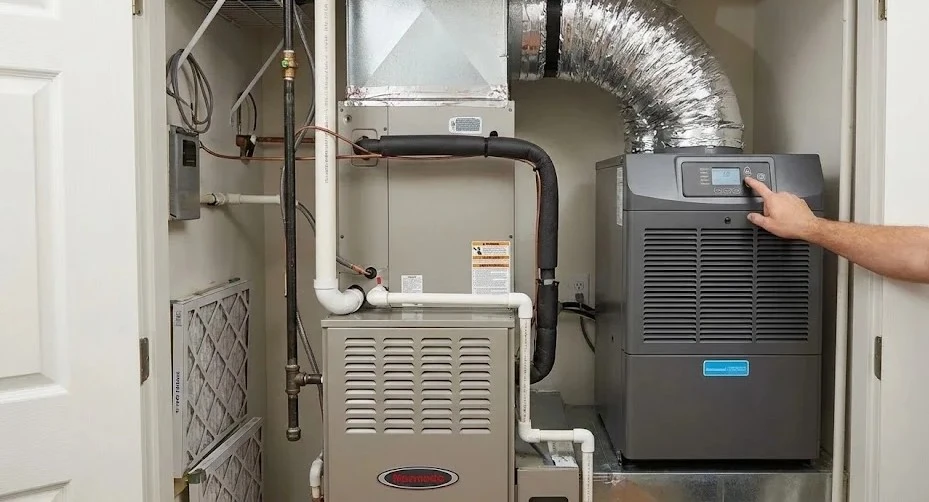
A whole-house dehumidifier removes moisture independently from cooling, helping keep the home in a healthier humidity range even when the AC isn't running.Unlike portable units, whole-house systems treat all the air in your home continuously. They maintain 45–50% RH year-round, protecting wood floors, trim, and finishes while reducing mold risk throughout the home.
Balanced humidity helps reduce conditions that support mold and moisture-related damage to woodwork and finishes. Many whole-house models include built-in digital control and low-maintenance designs intended for continuous operation.
HVAC Integrated vs. Dedicated Whole-House Dehumidifier Systems
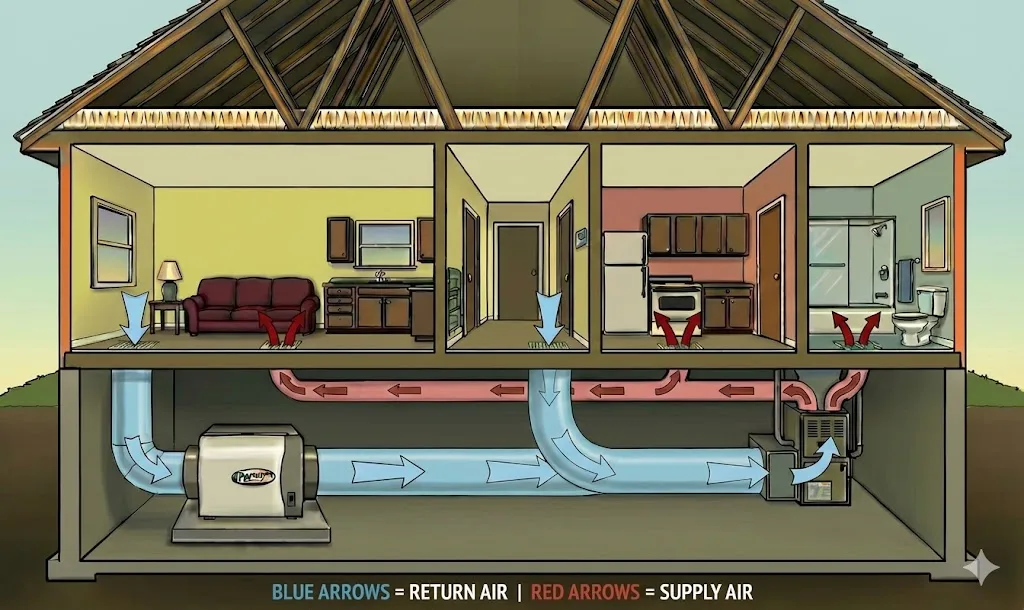
Systems can integrate into existing HVAC ductwork or operate with their own dedicated ductwork — the right choice depends on your home's layout and duct access.HVAC Integrated
- Connected to existing return and supply ductwork
- Distributes conditioned air through existing vents
- Hidden installation — no visible equipment in living areas
- Ideal for homes with accessible forced-air duct systems
- Controls can integrate with existing HVAC thermostat
Independent Systems
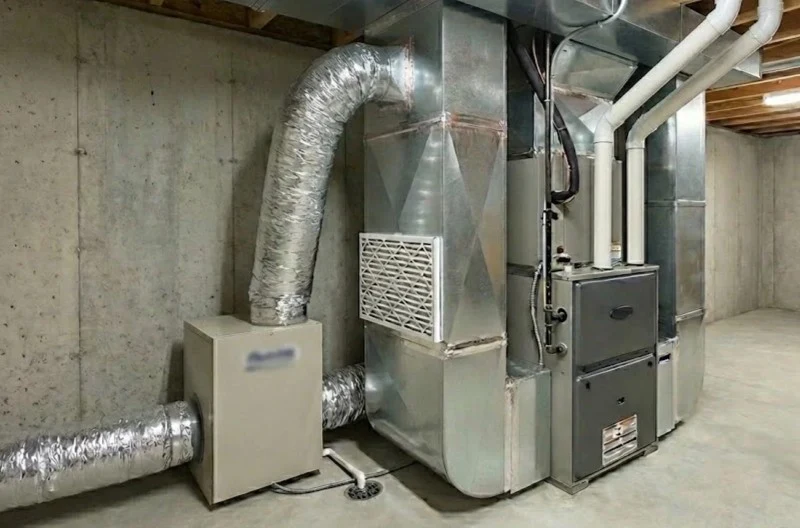
- Operates with its own dedicated ductwork — not tied to HVAC
- Installed in mechanical room, basement, or crawl space
- Self-contained airflow independent of heating and cooling
- Ideal when HVAC duct access is limited or unavailable
- Flexible placement and airflow design options
Many whole-house dehumidifiers are designed to integrate with forced-air systems and can also be installed to operate on their own, depending on the layout of the home.
Whole-House Dehumidification vs. Portable Units
A whole-house system treats your home's air through dedicated airflow and drains continuously — portable units only manage a single room and require frequent attention.Whole-House System
- Treats entire home — not just one room
- Continuous drainage — fully automatic
- Stable RH control strategy year-round
- Air conditioned and distributed with HVAC equipment
Portable Unit
- Room-limited coverage only
- Manual bucket emptying required
- Inconsistent RH control
- Not designed for continuous operation
- Less energy efficient than whole-house systems
Signs You May Need a Whole-House Dehumidifier
If indoor Relative Humidity consistently exceeds 55%, dedicated dehumidification may be necessary.Windows sweating or fogging on the inside
Musty odors present inside the home
Hardwood floors cupping or warping
AC runs constantly but house still feels humid
Basement or lower level humidity rising
Allergy or respiratory symptoms worsen at home
Condensation or mildew visible on interior surfaces
Our Whole-House Dehumidifier Installation Process
We size the unit, design airflow, install continuous drainage, integrate controls, then verify performance before we leave.Evaluate Humidity Patterns
Assess problem areas — basement, crawl space, main level — and identify moisture sources driving elevated RH.
Select System Type
Determine HVAC integrated or independent approach based on duct access, home layout, and moisture load.
Proper Sizing
Size for square footage, insulation levels, occupancy, and local climate data — not guesswork.
Install Continuous Drainage
Gravity drain or condensate pump installed. No manual emptying. Fully automatic operation.
Configure Controls & Verify RH
System programmed and tested to maintain 45–50% RH. Verified before completion.
Equipment Selection and Sizing
Proper sizing is based on square footage, volume, HVAC equipment, insulation levels, and moisture load — not guesswork.We perform a load calculation for every installation — accounting for home size, construction type, number of occupants, and local climate data. Industry guidance commonly references 40–60% RH as a recommended indoor range; we typically target 45–50% RH for comfort and mold-risk reduction in Raleigh homes.
An undersized unit runs continuously without reaching target RH. An oversized unit short-cycles and wastes energy. All systems include continuous drainage and professional integration into existing controls where applicable — calibrated to 45–50% RH before we leave the job.
If your crawl space is the primary driver of Whole-House humidity, see our encapsulated crawl space dehumidifier installation page.
Why Raleigh Homes Need Dedicated Humidity Control
Raleigh's humid subtropical climate pushes outdoor dew points above 70°F for much of the year, creating persistent indoor moisture challenges that air conditioning alone cannot manage.Average relative humidity in the Raleigh-Durham area stays above 70% outdoors from May through September, and shoulder-season months (March–April, October–November) regularly see dew points in the upper 50s to low 60s. Homes built on Piedmont red clay are especially vulnerable because clay soils retain moisture and release it slowly through foundations and crawl spaces.
Newer construction in neighborhoods across Holly Springs, Cary, Apex, and Fuquay-Varina often has tighter building envelopes. That improved insulation reduces energy costs but traps moisture inside — making a whole-house dehumidifier even more important in modern Triangle-area homes.
Older homes in established Raleigh neighborhoods face different challenges: leaky ductwork, unsealed crawl spaces, and aging HVAC systems that no longer control humidity effectively. In both cases, a properly sized whole-house dehumidifier fills the gap between what your AC can do and what your home actually needs.
Whole-House Dehumidifier Cost in Raleigh
Most whole-house dehumidifier installations in the Raleigh area run $3,000–$5,000 for a standard HVAC integration, and $4,000–$6,000 for more complex or older systems.Standard HVAC integrations connect to existing ductwork with straightforward drainage. More complex or older systems that require additional ductwork or electrical setup run toward the higher end. We provide an exact quote after evaluating your home — no surprises.
In terms of operating cost, a whole-house dehumidifier typically adds $8–$15 per month to your electric bill. Many homeowners offset some of that by running their AC less aggressively once humidity is controlled independently — when RH is at 45–50%, 76°F feels comfortable instead of needing to cool to 72°F.
Compared to running two or three portable units (which cost $200–$400 each, need frequent emptying, and only treat one room), a whole-house system is typically more cost-effective within the first two to three years while providing better coverage and no maintenance hassle.
Frequently Asked Questions
What is the ideal indoor humidity level for a home in Raleigh, NC?
For Raleigh-area homes, we target 45–50% Relative Humidity (RH). Industry guidance cites 40–60% RH as acceptable, but tighter control at 45–50% provides better mold prevention and comfort in North Carolina's humid climate.
Can a whole-house dehumidifier run without the AC?
Yes. Whole-house dehumidifiers operate independently of cooling, maintaining stable RH even when the AC is off during mild weather.
HVAC integrated vs. independent — which is better?
Both work well. HVAC integrated systems use existing ductwork for distribution. Independent systems have their own dedicated ductwork and airflow, making them suitable when HVAC duct access is limited.
Do whole-house dehumidifiers need a drain?
Yes. Continuous drainage is standard — gravity drain or condensate pump. No manual emptying required.
How long do whole-house dehumidifiers last?
Properly installed and maintained whole-house dehumidifiers typically last 7–10 years.
How much does a whole-house dehumidifier cost in Raleigh?
Most installations in the Raleigh area run $3,000–$5,000 for a standard HVAC integration, and $4,000–$6,000 for more complex or older systems. Operating cost is typically $8–$15 per month.
Will a whole-house dehumidifier increase my electric bill?
A whole-house dehumidifier typically adds $8–$15 per month to your electric bill. Many homeowners offset some of that cost by running their AC less aggressively once indoor humidity is independently controlled.
Related Reading
Schedule Your Home Evaluation
Serving Raleigh, Holly Springs, Cary, Apex, Fuquay-Varina, and surrounding Triangle communities.
Request Home Evaluation Fully Insured and Locally Owned. Serving the Triangle region.