Table of Contents
What Condensation on Your Windows Actually Means
Condensation on windows in summer is one of two different things, and they call for opposite reactions. Water on the inside of the glass usually means your indoor air is holding more moisture than it should. Water on the outside is normally harmless dew, but it does not prove that a window is either efficient or inefficient. The glass may have been cooled by indoor air conditioning or by overnight radiative cooling.
The Triangle’s hot, humid summers make both types of window condensation common. Summer air here is often humid enough for dew to form on cool exterior glass, especially on mornings that are already hot and humid outside. Telling the two apart takes about ten seconds, and it changes what you should actually do about it.
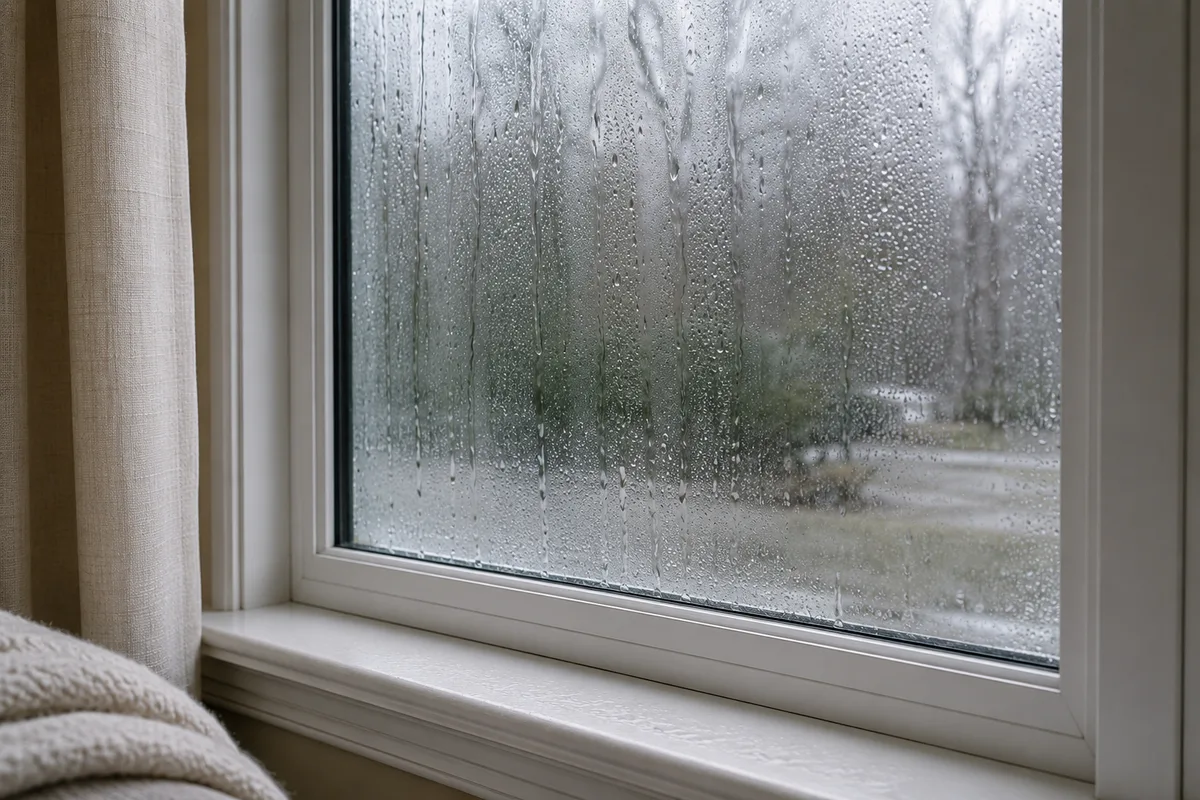
Condensation on the Inside of Your Windows
This is the one worth paying attention to. Indoor air holds water vapor, and when that air touches a surface cold enough, the vapor turns back into liquid. Window glass is often one of the cooler interior surfaces in a room, particularly near air-conditioning supply air or where airflow is limited, so it’s often where condensation shows up first.
Interior condensation forms when the glass surface temperature drops below the dew point of the indoor air, and higher indoor humidity raises that dew point, making condensation more likely. It seems backwards that this could happen when it’s 95°F outside, but well-insulated glass keeps the interior pane close to room temperature rather than the heat outdoors. So if air conditioning is running and indoor humidity stays high, the glass can still be cold enough to sweat. Bathrooms after showers, rooms with limited airflow, and areas near moisture-producing activities may show interior condensation first, but if it’s showing up on multiple windows across the house, the humidity problem isn’t isolated to one room.
Air leaks around the window panes and frame add to this. Gaps that let outdoor air infiltrate can bring hot, humid air right up against the cold interior glass, where it can condense almost instantly, even if the rest of the room’s humidity is under control.
Closed blinds, shades, or heavy curtains can reduce airflow across the glass and create a cooler, more humid air pocket near the window. Open them periodically and avoid tightly sealing coverings against the glass. That’s the same mechanism as a cold drink sweating on a humid day, just playing out on a bigger, flatter surface.
Condensation on the Outside of Your Windows
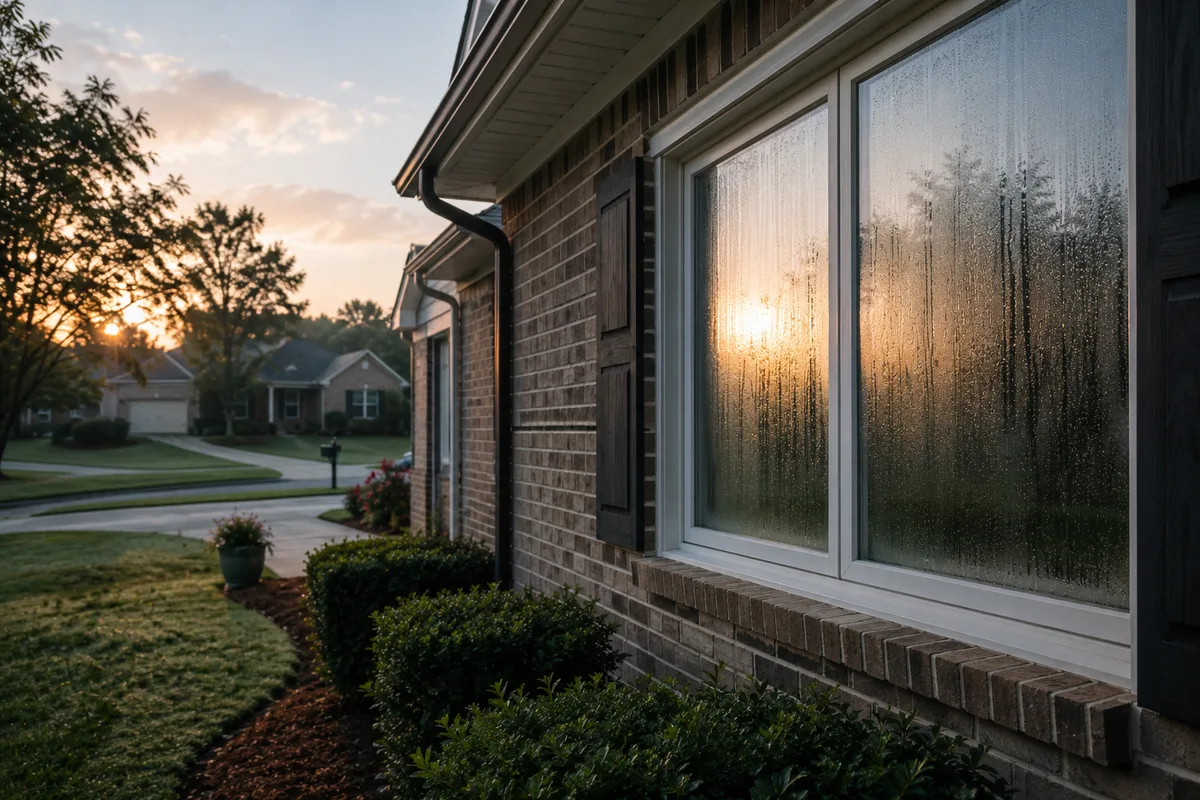
Exterior condensation can develop for two different reasons during a Triangle summer. In both cases, water forms when the outside surface of the glass falls below the dew point of the outdoor air.
The first scenario is common during our extremely humid mornings. Recent conditions around the Triangle have been approximately 77°F and 90% relative humidity at 6 a.m., producing an outdoor dew point near 74°F. That means the exterior glass only needs to be cooled about 3°F below the outdoor temperature for condensation to form. Air conditioning can conduct enough cooling through poorly insulated, single-pane, or otherwise low-performing glass to lower its exterior surface below that dew point. Better-insulated double-pane or Low-E glass limits this heat transfer, helping the exterior pane remain closer to the outdoor temperature and making this type of condensation less likely.
The second scenario is ordinary overnight dew. On a clear, calm night, glass can lose heat to the night sky and become slightly colder than the surrounding outdoor air. The glass radiates infrared heat toward the much colder night sky, and with few clouds or little wind, heat can leave the glass faster than the surrounding air replaces it. If its temperature falls below the outdoor dew point, moisture condenses on the exterior surface just as it does on a car windshield or lawn. This can occur on both older and energy-efficient windows. It may be more noticeable on shaded or north-facing windows because they warm more slowly after sunrise.
Exterior condensation is normally harmless, but it does not automatically prove that a window is either efficient or inefficient. Window insulation, indoor temperature, outdoor dew point, wind, cloud cover, shading and orientation all affect whether a particular window develops condensation. Exterior moisture usually evaporates as the glass warms. Moisture trapped between the panes is different and may indicate an insulating-glass seal failure that should be evaluated by a window professional.
Interior vs. Exterior: How to Tell the Difference
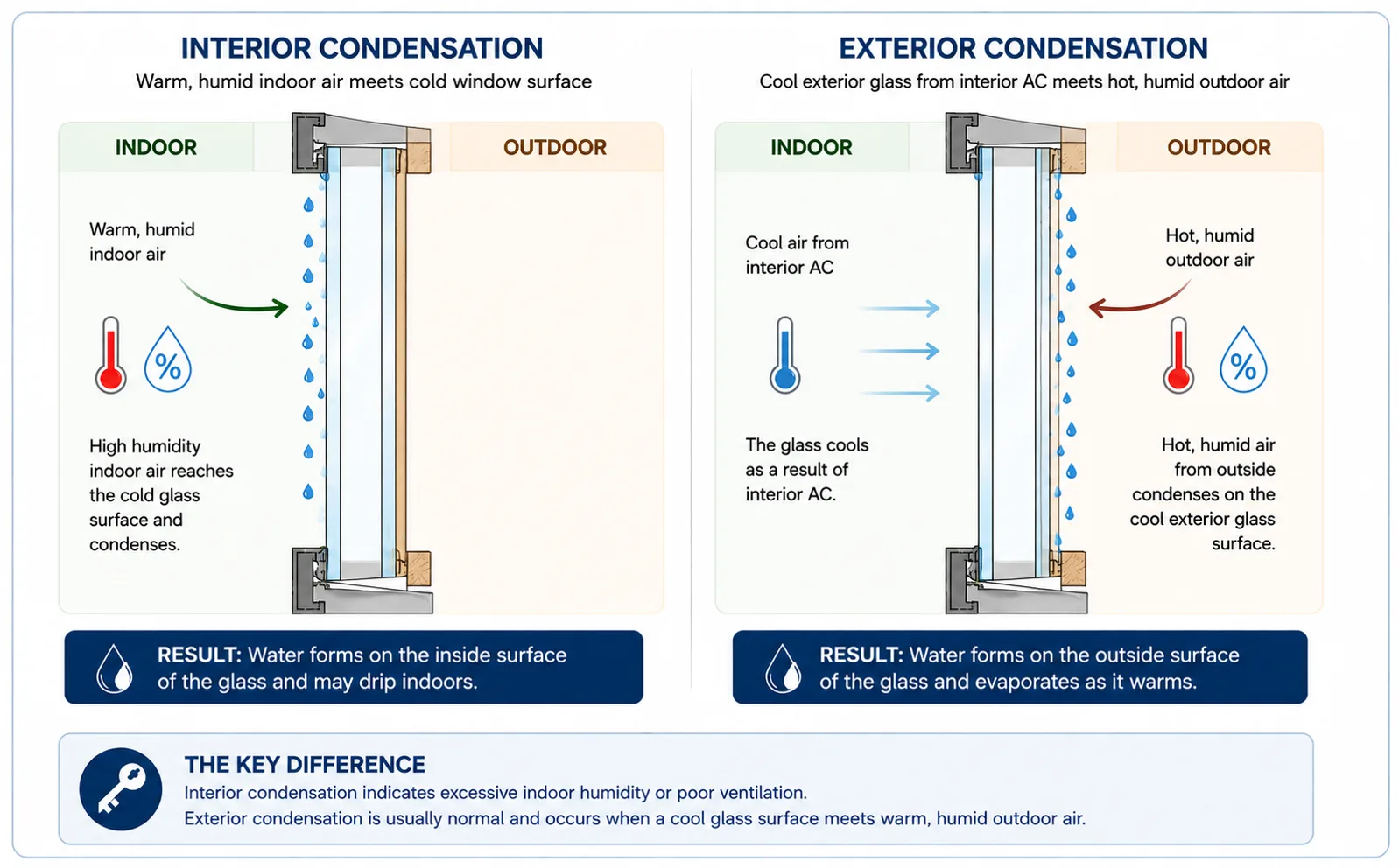
Touch the glass, or run a finger along the inside of the pane. If the moisture is on the inside surface, it’s interior condensation and worth investigating. If you have to go outside to touch it, or it’s visible through the glass from indoors but the inside surface is dry, it’s exterior dew.
Timing is another clue. Exterior condensation is almost always an early-morning event that burns off as the sun comes up. Interior condensation can show up any time indoor humidity is high, and may persist until the glass warms, indoor humidity is reduced, or airflow across the window improves.
If the fogging or droplets are between the glass panes and cannot be wiped from either side, the insulated-glass seal may have failed. A dehumidifier will not correct that condition; contact a qualified window contractor or manufacturer.
When Window Condensation Signals a Bigger Problem
Interior condensation on one window in a steamy bathroom after a shower is normal. Interior condensation on several windows across the house can indicate a home-wide humidity-control issue, especially when it’s accompanied by musty odors, sticky air, recurring mold, or crawl-space moisture concerns.
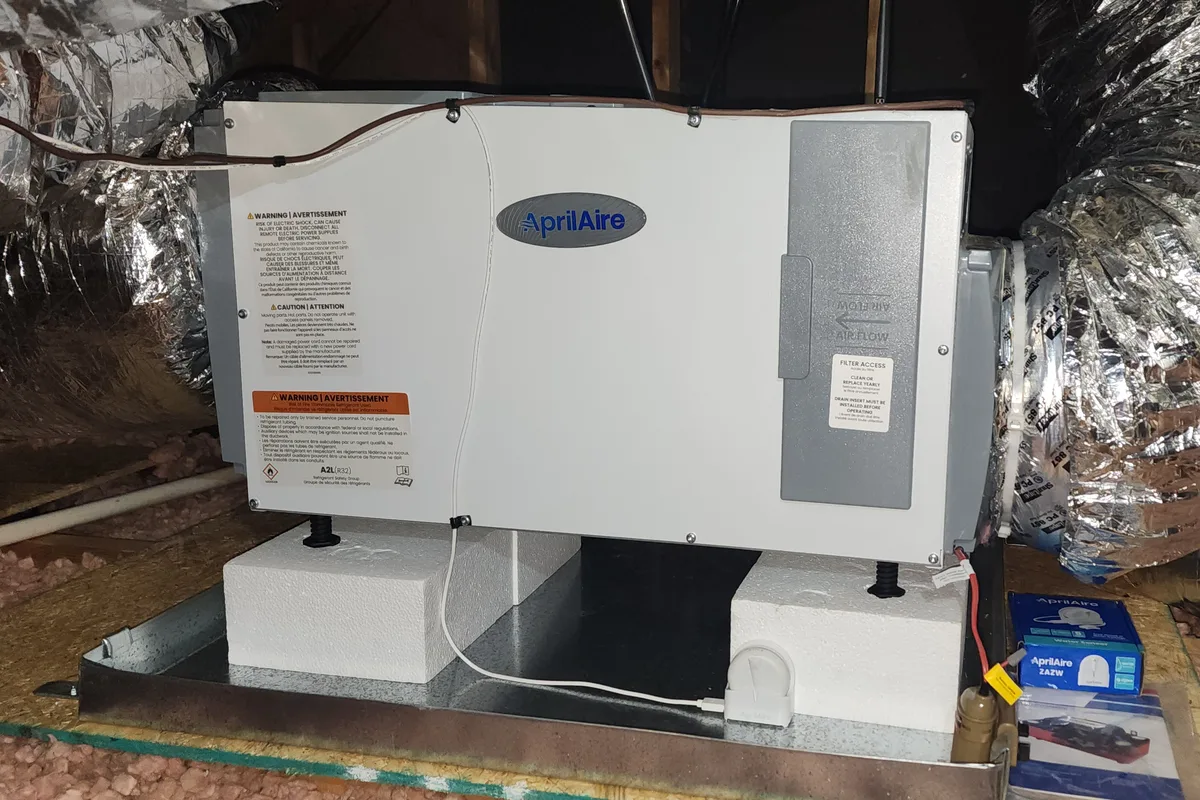
A properly sized and installed whole-house dehumidifier can help maintain a more consistent indoor RH target in the 45–50% range, including during periods when the air conditioner isn’t running enough to remove adequate moisture. That matters in the Triangle because air conditioning alone often can’t keep up with summer humidity, even when the temperature feels comfortable. If you’re already seeing some of the signs listed above, it’s worth checking our list of 5 humidity warning signs to see what to do about each one, and if a whole-house dehumidifier is right for you. For windows specifically, check for the following:
- Condensation shows up on more than one window, not just the steamiest room in the house.
- The moisture is on the inside of the glass, not the outside.
- It lingers for hours rather than clearing by mid-morning.
- Musty smells, sticky air, or visible mold accompany it.
Frequently Asked Questions
Is condensation on the outside of my windows a problem?
Not usually. Exterior condensation happens when air conditioning cools older or poorly insulated glass from the inside, and that cooling reaches the outside surface. When outdoor air is very humid, which is common on Triangle mornings that are already above 80°F, that humid air condenses on the cooled glass. It's not, by itself, evidence of a window or indoor-humidity problem, and it's less common on newer, well-insulated glass. If moisture shows up between the panes rather than on the surface, that can indicate a seal failure and is worth having a window professional look at.
Why does condensation only happen on some windows and not others?
Different windows can have different surface temperatures because of their insulation value, glass construction, indoor cooling, orientation, shading and airflow. During hot, humid weather, poorly insulated glass may conduct more cooling from the air-conditioned interior and develop exterior condensation while better-insulated glass stays dry. On clear, calm nights, radiative cooling can also cause certain windows, especially shaded windows, to fall below the outdoor dew point.
What indoor humidity level should I keep to avoid interior window condensation?
Triangle Dehumidifiers generally targets 45–50% RH for Triangle homes. Avoid setting humidity unnecessarily low; comfort, wood movement, and the appropriate target can vary by season, home construction, and occupants' needs. Condensation risk rises when indoor moisture pushes the dew point above the temperature of the interior glass.
Does a whole-house dehumidifier stop window condensation?
It can greatly reduce or eliminate interior condensation caused by elevated indoor humidity when the system is properly sized, installed, and set up. It will not correct condensation caused by failed insulated-glass seals, unusual glass-surface temperatures, water intrusion, or moisture between panes. It also won't stop exterior condensation. Even on windows where AC-cooled air is reaching the outer glass, exterior condensation is triggered by outdoor humidity, and a whole-house dehumidifier only controls the humidity inside your home.
Not Sure Which One You’re Seeing? We’ll Measure It.
Guessing at indoor humidity from window condensation alone only tells part of the story. Triangle Dehumidifiers, LLC provides free home evaluations throughout Wake County and the Triangle, measuring your actual indoor RH and identifying whether a whole-house dehumidifier, a crawl space dehumidifier, or both would fix what you’re seeing.
Call or text us at (919) 867-0580, or request your free evaluation online. We serve Raleigh, Cary, Apex, Holly Springs, Fuquay-Varina, Garner, Wake Forest, Knightdale, Morrisville, Durham, and Chapel Hill.