Table of Contents
What a Musty Smell in the House Usually Means
A persistent musty smell often points to damp materials and possible mold growth. In Triangle homes built over a crawl space, it’s one of the most important places to look. Air from down there moves up through the floor, and when ductwork runs through the crawl space, it can come out of the supply registers too. Plumbing leaks, damp furnishings, and HVAC moisture problems can also play a part.
The EPA is specific about what the smell actually is. Mold releases gases called microbial volatile organic compounds, and as the EPA puts it, “a moldy odor suggests that mold is growing in the building and should be investigated”. The smell is just a byproduct of the real problem, which is moisture.
Where the Smell Usually Comes From
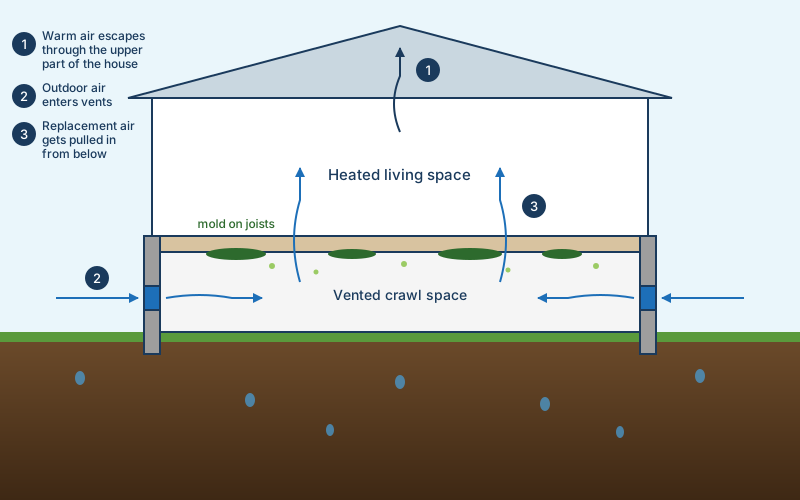
A large share of Triangle homes, especially older ones, sit on a vented crawl space. Foundation vents were meant to dry that space out, but in a climate like ours, they do the opposite. The Department of Energy’s Building America Solution Center states it plainly: in humid climates “the vents can actually encourage condensation in the crawlspace by allowing warm, humid air to enter and condense on the floor joists.”
Vented crawl spaces in the Triangle commonly run 70–85% RH through the summer. Advanced Energy, the Raleigh research organization behind the Southeast’s closed crawl space field studies, found that closed crawl spaces stay substantially drier than wall-vented ones in humid weather, holding near 60% RH even in summer, while the wall-vented ones often ran above 80%.
Subfloor, floor joists, paper-faced batt insulation, and settled dust all take on that moisture. Wake County’s Piedmont clay adds a second source from below, since it drains slowly and holds soil moisture well into the fall. When crawl space RH stays above about 65% for extended periods, mold risk climbs, especially where materials stay damp or condensation forms. A humidity reading can’t tell you whether mold is actually growing, but it can tell you whether the conditions for it are there.
Once the weather cools, air movement does the rest. When the house is warmer than the air outside, warm air rises and escapes through the upper part of the house, around the attic hatch, recessed lights, and the chimney chase. That pulls replacement air in low, and in a home over a vented crawl space, much of it comes through the crawl space itself, around duct penetrations, plumbing chases, and the gap at the sill plate. Building scientists call this the stack effect, and it gets stronger the colder it gets outside. Leaky return ducts in the crawl space add to it by pulling crawl space air straight into the system any time it runs. In practice, some of the air you smell in the hallway may have spent time in the crawl space first.
How to Find Where the Odor Is Coming From
You can usually narrow down the source within a few days with a flashlight and an inexpensive hygrometer.
- Open the crawl space access door and smell the air at the opening. You don’t need to go in. If the crawl space smells similar to the rooms above, that’s a strong clue it may be contributing to the odor. You’ll still need an inspection to find the moisture source and confirm whether mold is present. Leave the crawling and the close look at the joists to someone with a respirator and protective gear, since disturbing mold puts spores into the air you’re breathing in a tight space.
- Watch whether the odor tracks the HVAC. A smell that shows up shortly after starting the system points at the ductwork or the air handler, and in many Triangle homes one or both of those sit in the crawl space.
- Check the still, closed spaces first. Closets on exterior walls, cabinets under sinks, and the wall behind furniture pushed against an outside wall hold stagnant air and show the problem earlier than an open living room does.
- Leave a hygrometer in the worst room for three or four days. Readings that stay at 60% or higher mean the house is holding more moisture than it should. The EPA recommends keeping indoor humidity “below 60 percent (ideally between 30 and 50 percent) relative humidity”.
Here’s how to read the number:
| RH reading | What it means |
|---|---|
| 45–50% | Our target range |
| Above 50% but below 60% | Above our target. Monitor conditions and look for persistent dampness or condensation. |
| 60% or higher | Above the EPA’s recommended indoor range. Investigate and correct the moisture source. |
If the crawl space smells fine and the odor stays in one room, look for a local source instead. A slow supply line under a sink, a washing machine drain, or a shower wall wicking water into the framing will all do it.
Why the Smell Gets Worse in the Fall
A musty smell often gets noticeably worse once the weather turns, and there are two reasons for it.
-
The air conditioner stops running as much. Dew points in the Triangle stay elevated into early October, but with mild afternoons the system short-cycles or sits idle, so the incidental dehumidification it provided all summer largely stops. Indoor humidity drifts up even though the house feels cooler.
-
The heat comes on for the first time. Once the house is warmer than the air outside, the stack effect gets stronger and pulls harder on the crawl space. The first few heating cycles also move whatever musty air has collected in the ductwork and air handler over the summer. A crawl space that spent June through September at 70–85% RH has months of moisture built up in its wood and insulation, sometimes with mold growth. Cooler weather is when air from down there starts reaching the rooms above in earnest.
What Actually Gets Rid of a Musty Smell
Odor treatments work on the smell, not the water. Charcoal bags, candles, and plug-in fresheners knock it down for a few days, but it comes back because the material producing it is still damp. The real fix has three parts in this order: stop the moisture, clean what already grew, then hold humidity low enough that it doesn’t start again.
For a vented crawl space, our minimum is a vapor barrier covering 100% of the ground, closed foundation vents, and a properly sized dehumidifier. We don’t install a dehumidifier on bare dirt with the vents open, because the unit would never keep up with the moisture load. Plumbing leaks, standing water, drainage problems, and damaged materials also have to be fixed. If there’s a gas furnace or water heater down there, closing up the crawl space has to account for its combustion air and for local code requirements.
A crawl space dehumidifier install runs an estimated $3,000–$5,000 in a vented crawl space with the vents closed as part of the work, plus about $1 per square foot for the vapor barrier if the ground isn’t already covered. In a crawl space that’s already sealed, it runs $3,000–$4,000. Triangle Dehumidifiers installs AprilAire E070W, E080W, E100W, and E130W units and sets them to hold 45–50% RH year-round. A dehumidifier uses electricity, so don’t count on lower utility bills. Its job is humidity control.
That setup works well, and it’s a real option on its own. The walls stay unlined, though, so some air still leaks in around the closed vents and the access door, and moisture still comes through the foundation walls. Our post on a crawl space dehumidifier without encapsulation covers how that option performs.
Where growth is already established on joists and subfloor, crawl space mold treatment runs an estimated $1,500–$4,000 depending on square footage and severity, and it only holds if the moisture source gets corrected at the same time.
Full encapsulation goes further: a 100% ground-cover vapor barrier, foundation walls insulated with foil-faced foam board, and vents permanently sealed, with a dehumidifier holding the encapsulated crawl space at 45–50% RH. The encapsulation work is available through our sister company, Peak Energy, Inc., and Triangle Dehumidifiers handles the dehumidifier. Full encapsulation with a dehumidifier runs an estimated $7,500–$15,000 depending on crawl space size, drainage, and current conditions, and drainage or waterproofing may still be needed where liquid water gets in.
In an Advanced Energy field study of twelve matched homes in eastern North Carolina, homes with closed crawl spaces used, on average, at least 15% less energy for space heating and cooling than homes with wall-vented crawl spaces. Actual savings in an existing home depend on its construction, ductwork, insulation, and the scope of the work. For a side-by-side look at the two approaches, see crawl space encapsulation vs. a dehumidifier.
If the musty air is being generated in the living space rather than below it, a whole-house dehumidifier tied into the air handler is the better tool. That’s a different diagnosis and a different number, an estimated $4,500–$5,500 for a standard HVAC integration.
Side by side, the options look like this:
| Option | What it fixes | What it doesn’t fix | Estimated cost |
|---|---|---|---|
| Odor treatments (charcoal, candles, plug-in fresheners) | Masks the smell for a few days | The damp material producing it | Low |
| Dehumidifier with 100% vapor barrier and closed vents | Reduces crawl space humidity and the conditions that support new growth | Air leaking in at the vents and access door, moisture through unlined walls, existing growth | $3,000–$5,000, plus about $1 per sq ft for the vapor barrier |
| Full encapsulation with dehumidifier | Crawl space humidity, outside air leakage, and foundation wall moisture. May improve heating and cooling efficiency; savings vary by home. | Growth that’s already there, or liquid water from drainage problems | $7,500–$15,000 |
| Crawl space mold treatment | Existing growth on joists and subfloor | The humidity, so growth returns unless moisture is also fixed | $1,500–$4,000 |
| Whole-house dehumidifier | Humidity generated in the living space | A crawl space moisture source | $4,500–$5,500 |
When You Need Mold Treatment
If you can see growth on the joists or subfloor, you don’t need an air test to confirm it. The EPA’s position is that “in most cases, if visible mold growth is present, sampling is unnecessary.” Money spent on sampling is better spent on drying the space out.
The EPA recommends drying water-damaged materials within 24–48 hours, but crawl space humidity is a different problem. Lowering it keeps new growth from starting, though mold that’s already there still has to be cleaned up.
Our posts on what causes crawl space mold in NC homes and how professional crawl space mold treatment works cover the moisture sources behind it and what a proper cleanup involves.
Signs the Odor Is Coming From Below
- Musty air is strongest on the first floor and fades as you go upstairs
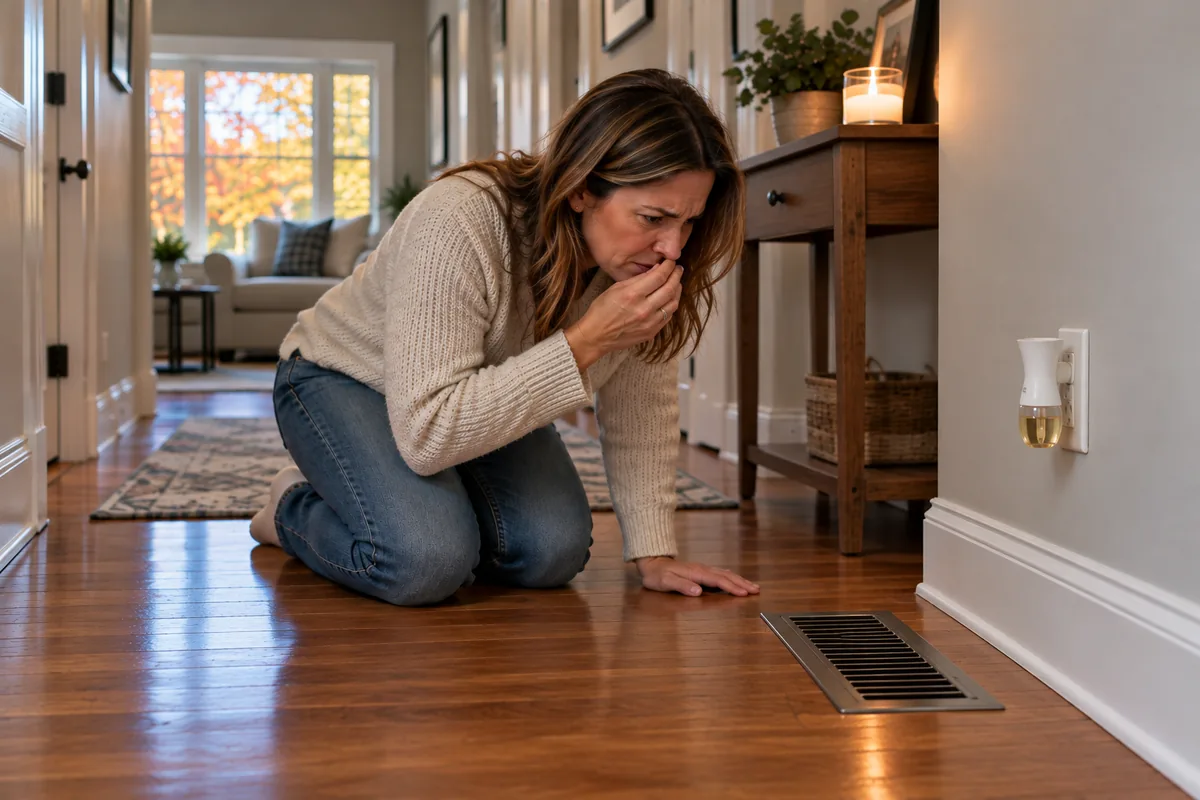
- Floor registers, or the area around the return, smell worse than the rest of the room
- Hardwood on the first floor has cupped or opened up gaps
- The crawl space access door, opened, smells like the inside of the house only stronger
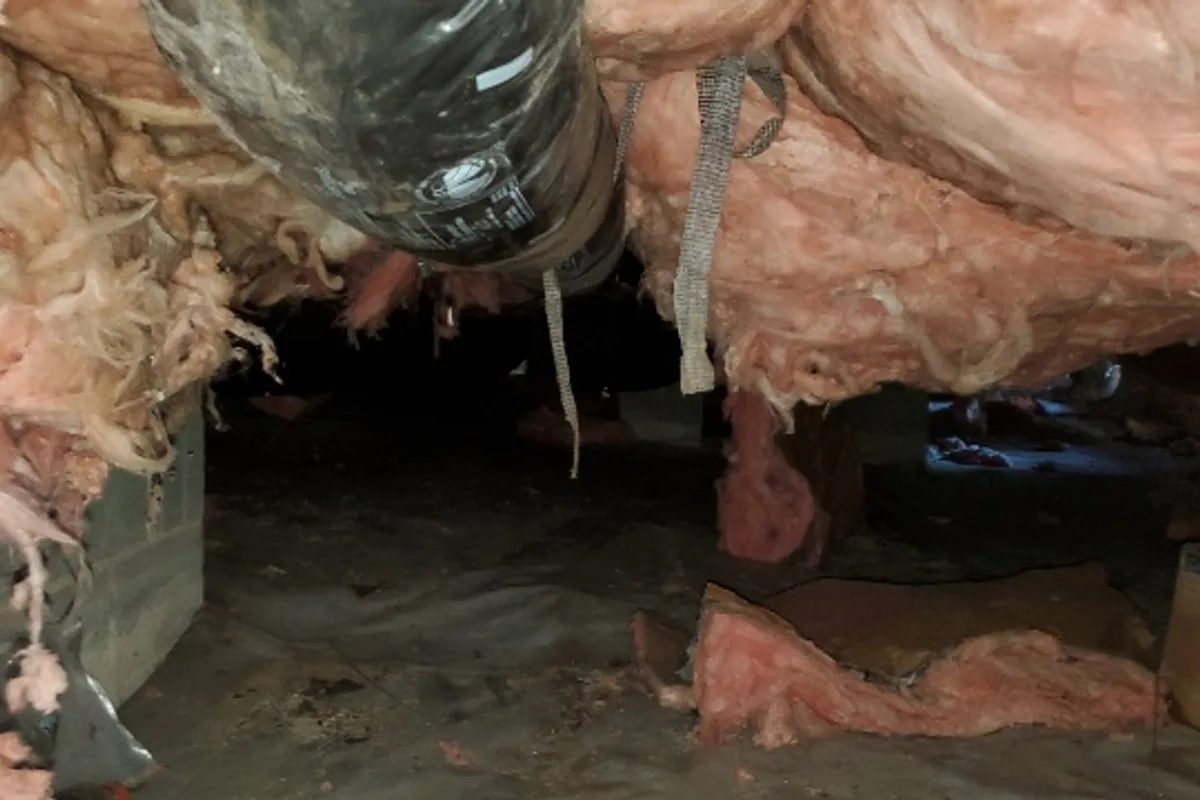
- Insulation between the joists is sagging or has dropped out in places
Several of these signs together justify a crawl space inspection, but they don’t confirm the source on their own. Cupped flooring and sagging insulation usually mean the framing has been damp for a while, and left alone, that moisture can lead to wood rot in the crawl space. The other warning signs of a humidity problem are worth reading alongside this.
Frequently Asked Questions
Why does my house smell musty when I can't find any mold?
If mold is involved, it's usually somewhere you aren't looking. Crawl space joists, the top surface of batt insulation, the back of baseboard on an exterior wall, and the inside of ductwork are all common locations, and none of them are visible from inside a room. The EPA treats a musty odor as reason to investigate even when nothing is visible, because the gases that carry the smell travel on air from wherever the growth is. Start by smelling the air at the crawl space access door, without going in.
Will a dehumidifier get rid of the musty smell?
A crawl space dehumidifier can help reduce musty odors when excess crawl space humidity is contributing to the problem. It works best alongside a full ground vapor barrier, closed vents, fixing any leaks or drainage problems, and cleanup of existing mold. Triangle Dehumidifiers doesn't install one on bare dirt with the vents open, because the unit would never keep up with the moisture load. Holding the crawl space at 45–50% RH limits the conditions that support new growth and lets damp wood and insulation dry out.
Does an air purifier fix a musty smell?
No. A filter captures particles, and a carbon filter can reduce the odor in the room it sits in. Neither one changes the humidity in the crawl space, so the source keeps producing. An air purifier is fine alongside moisture control, but it's no substitute for it.
How long after fixing the moisture does the smell go away?
There's no set timeline. It depends on how wet the wood and insulation were, whether the mold has been cleaned up, and whether things that soak up odor, like carpet, upholstery, or cardboard stored in the crawl space, need to be cleaned or thrown out. If the smell is still there after the work is done, have the crawl space looked at again rather than waiting it out.
Find Out Where the Smell Is Coming From. Get a Free Inspection.
A musty smell is the one humidity symptom homeowners try hardest to cover up, but it can usually be traced to its source. An on-site inspection, with a moisture meter and a hygrometer in the crawl space, will tell you whether the odor is coming from below and what it will take to stop it.
Triangle Dehumidifiers, LLC is a crawl space dehumidifier and moisture control company in Holly Springs, NC, serving Wake County and the broader Triangle region. Inspections are free. We measure the crawl space, check current humidity, and give you a written quote with no upsells and no scare tactics.
Call or text us at (919) 867-0580 or request your free inspection online. We serve Raleigh, Cary, Apex, Holly Springs, Fuquay-Varina, Garner, Wake Forest, Knightdale, Morrisville, Durham, and Chapel Hill.