Table of Contents
ERV vs. HRV: Which One Fits a North Carolina Home?
For almost every home in Raleigh, Cary, Apex, and the rest of Wake County, the answer is an ERV. An energy recovery ventilator transfers heat and moisture between the outgoing and incoming airstreams. A heat recovery ventilator transfers heat only. In a climate where summer dew points sit in the mid 60s to low 70s from June through August and the air stays muggy well into September, the unit that does something about incoming moisture is the one that belongs here.
If you are pricing ventilation this fall, there is more to it than that. The ERV’s moisture advantage is smaller than most product pages suggest, and neither unit is a humidity fix.
By late September in the Triangle, most homes have had the windows shut since May. Nights start to cool off, but the humidity often hangs on into early October, so the windows stay closed. Living with months of the same stale air in a tight house is what sends homeowners looking at ventilation in the first place.
Triangle Dehumidifiers, LLC in Holly Springs, NC installs ERVs, whole-house dehumidifiers, and filtration for Wake County homeowners. This post covers what actually separates the two systems, why the ERV wins here, the one case where an HRV would make sense, and what neither unit will do for you. If you are new to ventilation, start with what an ERV is and whether you need one.
What Is Actually Different Inside the Two Units
Both units do the same basic job. Two fans, four duct connections, two airstreams that pass each other without ever mixing. Stale indoor air goes out, fresh outdoor air comes in. The exchange core in the middle is where they part ways.
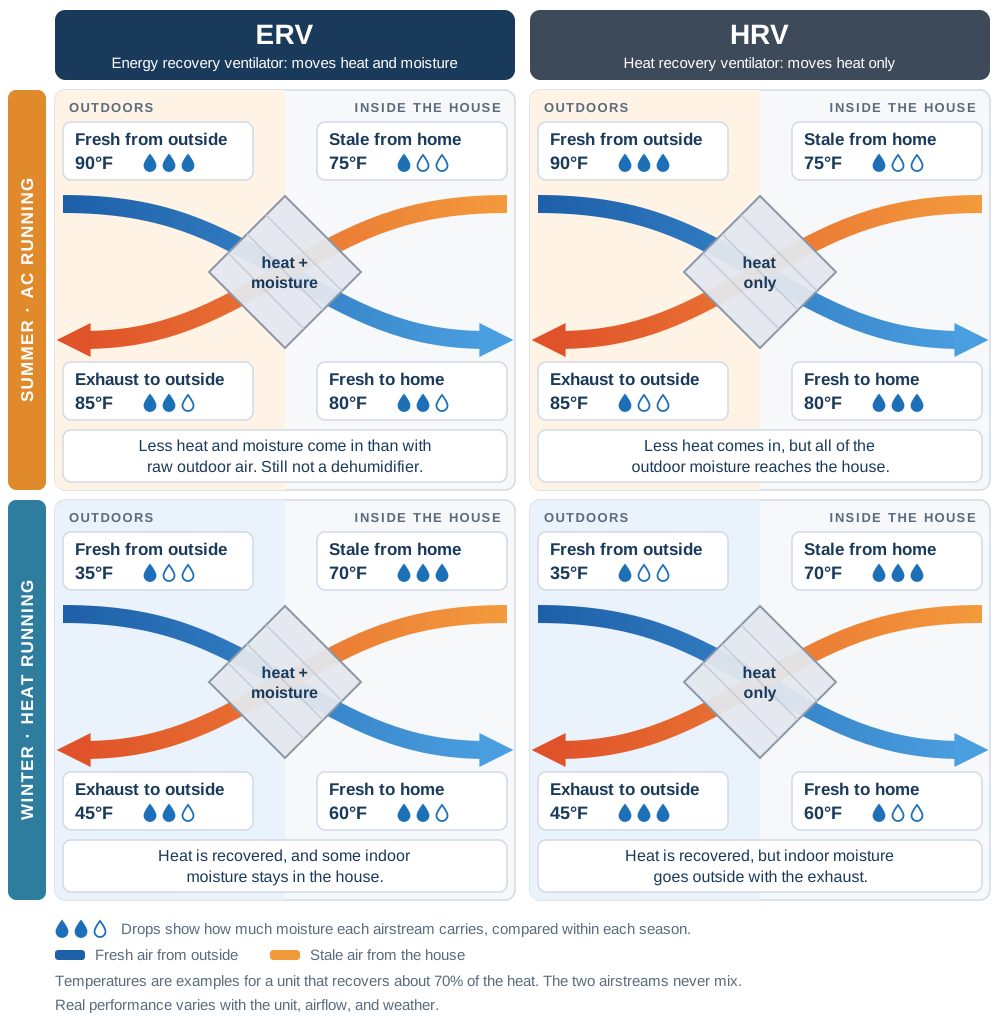
An HRV core transfers sensible heat only. Warm outgoing air gives up some of its heat to cold incoming air in winter, and the reverse happens in summer. Moisture rides straight through with the incoming air.
An ERV core is built from a material that carries water vapor along with the heat, usually called an enthalpy core. The U.S. Department of Energy’s Building America guide to whole-house ventilation describes it this way: “The main difference between an HRV and an ERV is that an ERV is able to transfer moisture as well as heat from the more humid air to the drier air.”
In July that means part of the moisture in the incoming outdoor air transfers to the outgoing stream before the fresh air reaches your living space. In January it works the other way, holding some indoor moisture in the house instead of dumping it outside.
| ERV | HRV | |
|---|---|---|
| Transfers heat | Yes | Yes |
| Transfers moisture | Yes | No |
| NC summer | Brings in less moisture than raw outdoor air | Brings in the full outdoor moisture load |
| NC winter | Holds some indoor moisture in the house | Exhausts indoor moisture |
| Best climate | Humid and mixed-humid, including the Triangle | Cold and dry |
Why an HRV Is the Wrong Fit for a Raleigh Summer
Run an HRV through a Wake County August and every bit of moisture in that outdoor air lands inside the house. The unit takes the edge off the heat and does nothing else. Your air conditioner and whatever dehumidification you have then work to remove the moisture a fan just brought in.
The EPA’s guide to mold, moisture, and your home sets the target: “Keep indoor humidity below 60 percent (ideally between 30 and 50 percent) relative humidity.” Pushing raw summer air into a conditioned house works against that number every hour it runs.
An ERV moves you in the right direction, but not as far as the brochures imply. It pulls some of the moisture out of the incoming air, not most of it. Broan’s HVI-certified spec sheet for its ERV100S, for example, rates cooling-season moisture transfer at 41 to 50 percent depending on airflow, so roughly half at best. That means an ERV adds less moisture to your house than an HRV does, and neither one removes moisture already inside.
DOE’s guidance backs up the caution. ERVs “seem to perform best during peak outdoor conditions and lose efficiency during low-temperature, high-humidity conditions.” In the Triangle that means the mild, muggy stretches of spring and fall, like a 72°F day after overnight rain with the air close to saturation. Indoor and outdoor temperatures are nearly the same, so the core has little to work with. The AC barely runs on days like that, and the moisture that comes in with the fresh air stays in the house. That is why sizing and pairing matter more here than the numbers on a brochure.
Is There Any Case for an HRV in North Carolina?
In a cold climate, yes. In places like Minnesota and Maine, a tight house can build up enough moisture over a long winter to fog and frost the windows, and exhausting that moisture helps. An HRV does that, and the short, mild summers there cost it very little.
North Carolina is not that climate. Wake County sits in the mixed-humid zone and gets 43–50 inches of rain a year. Summer is the season that decides it here, and it is long and muggy. Triangle homes rarely have so much winter moisture that exhausting it is worth letting the full outdoor moisture load in all summer.
For most Triangle homes, Triangle Dehumidifiers recommends an ERV over an HRV for that reason, though the right choice always depends on your home and HVAC system. If a contractor quotes an HRV for a home in Raleigh or Cary, it is fair to ask how it will handle the moisture in July.
An ERV Will Not Dry Out Your House
An ERV is a ventilator. It exchanges air. Holding a house at a steady relative humidity is a different job, done by a different machine.
Homeowners regularly call believing an ERV will fix a muggy house. It will not. If sticky air is the main complaint, ventilation is not the first thing to buy. Our post on why your house feels muggy even with the AC running covers what actually drives that.
In a Triangle summer the two systems do different work, and plenty of homes need both. The ERV handles fresh air, CO2, and lingering odors. A whole-house dehumidifier holds indoor humidity in the 45–50% RH range, well below where mold and dust mites take hold, and the air stops feeling heavy. Running ventilation without humidity control in July can push indoor RH the wrong way, which is why the two get designed together instead of sold separately.
How an ERV Gets Sized for Your Home
Fresh air rates come from ASHRAE Standard 62.2, which sets a minimum from floor area and bedroom count rather than a rule of thumb. The current version asks for 0.03 cfm per square foot of conditioned floor area, plus 7.5 cfm for each bedroom plus one. A 2,000 square foot, three-bedroom home works out to roughly 90 cfm of continuous ventilation.
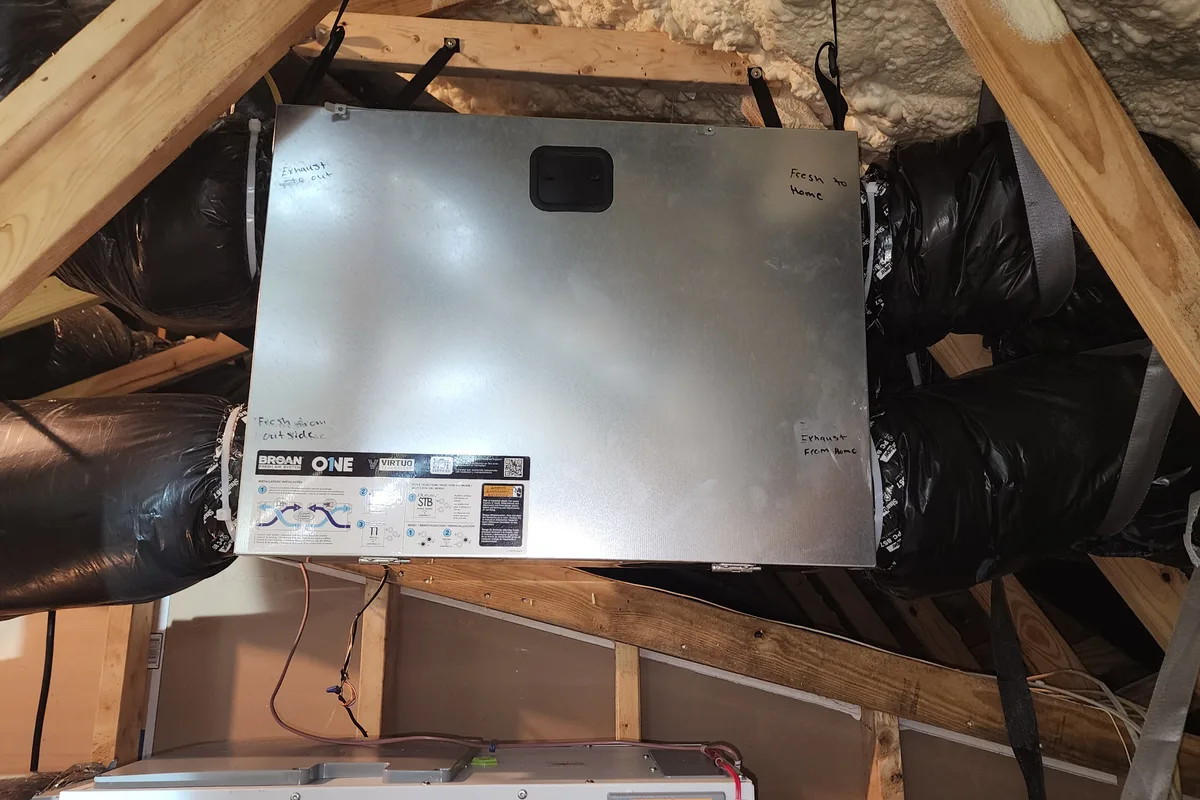
That number drives unit selection, duct sizing, and where the equipment goes. Most Triangle installs put the ERV in the attic or an encapsulated crawl space with insulated duct runs to the living space, and the fresh air either ties into the return side of the HVAC or runs to its own supply registers. How ERV installation works walks through the full process.
Rates in the standard assume the system runs continuously. DOE notes that cycling is permitted and “allows use of larger fans than are needed, without over-ventilating the dwelling.” In practice, continuous operation at low speed with a boost setting holds CO2 down without dumping outdoor moisture into the house in bursts.
Installed ERV cost in the Triangle runs an estimated $5,000–$7,000, depending on duct accessibility and the unit selected.
Signs Your Home Needs Ventilation, Not More AC
- The primary bedroom feels stale and stuffy by morning even though the AC ran all night
- Cooking smells and pet odors hang around for hours instead of clearing out
- A new build or a recent remodel still has an off-gassing smell after a year
- Someone in the house wakes up groggy or headachy in a closed bedroom
- A CO2 monitor in the bedroom reads above 1,000 ppm by morning
Two or more of those point to an air exchange problem. Sticky air, condensation on windows, and mildew smell point somewhere else. A free inspection sorts out which problem you actually have before anyone quotes equipment. Our guide to indoor air quality for NC homes covers which CO2 monitor to use and the rest of what builds up in a closed-up Triangle house.
Frequently Asked Questions
Is an ERV better than an HRV?
In North Carolina, yes. An ERV transfers moisture along with heat between the two airstreams, so less of the outdoor humidity reaches your living space. An HRV transfers heat only and lets the full summer moisture load straight in. In a dry northern climate the HRV can be the better choice, but in Wake County the ERV is the right fit for almost every home.
Do I need a dehumidifier if I have an ERV?
Usually yes. An ERV is a ventilator, not a dehumidifier. It brings in less moisture than an HRV or an open window would, but it does not hold your home at a set relative humidity. A whole-house dehumidifier is what keeps indoor air in the 45 to 50 percent RH range. In a Triangle summer, many homes need both systems working together.
Should I run my ERV in the winter?
Yes. Ventilation rates in ASHRAE 62.2 assume continuous operation year round. Windows stay shut in winter too, and your home's need for fresh air does not stop with the season. An ERV holds some indoor moisture in the house during winter rather than exhausting it, so running it does not dry the house out the way an HRV would.
What size ERV do I need for a 2,000 square foot house?
ASHRAE Standard 62.2 sets the target at 0.03 cfm per square foot of conditioned floor area plus 7.5 cfm for each bedroom plus one. A 2,000 square foot, three-bedroom home works out to roughly 90 cfm of continuous ventilation. Duct runs, unit location, and how the fresh air ties into the HVAC all affect the model selected.
Not Sure Whether You Need Fresh Air, Humidity Control, or Both?
Ventilation and humidity control solve two different problems, and buying the wrong one is an expensive way to find that out. Fall is the practical time to sort it out in the Triangle, before another heating season of closed-up air.
Get a free inspection and an exact quote. We will measure your CO2 and humidity, look at your HVAC setup, and tell you which problem you actually have. You get a written quote with no upsells and no scare tactics. Call or text, or request a visit online.
We serve Raleigh, Cary, Apex, Holly Springs, Fuquay-Varina, Garner, Wake Forest, Knightdale, Morrisville, Durham, and Chapel Hill.