Table of Contents
What Actually Happens During an ERV Install
If you’ve decided your Triangle home needs an energy recovery ventilator, the next question is usually practical: what does the crew actually do, and how disruptive is it? An ERV installation is mostly about sizing the airflow correctly and routing ductwork well. It is not just mounting a box in the attic or crawl space.
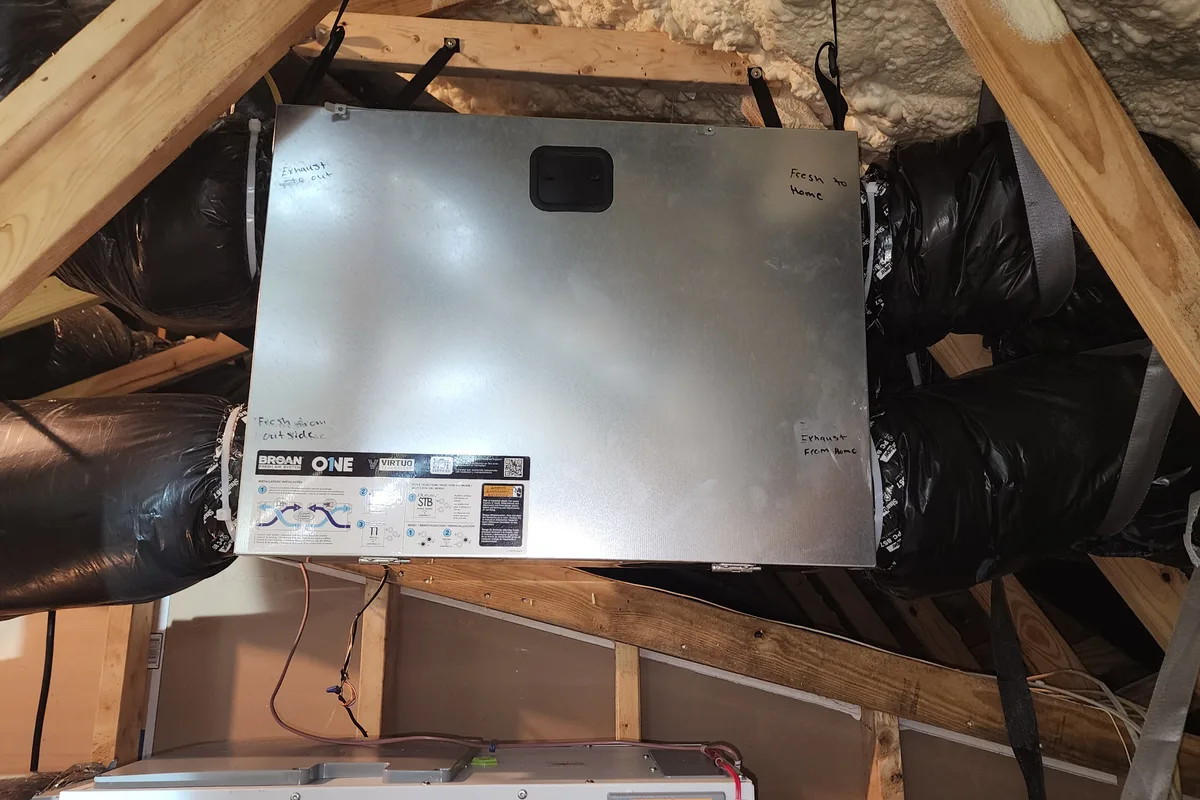
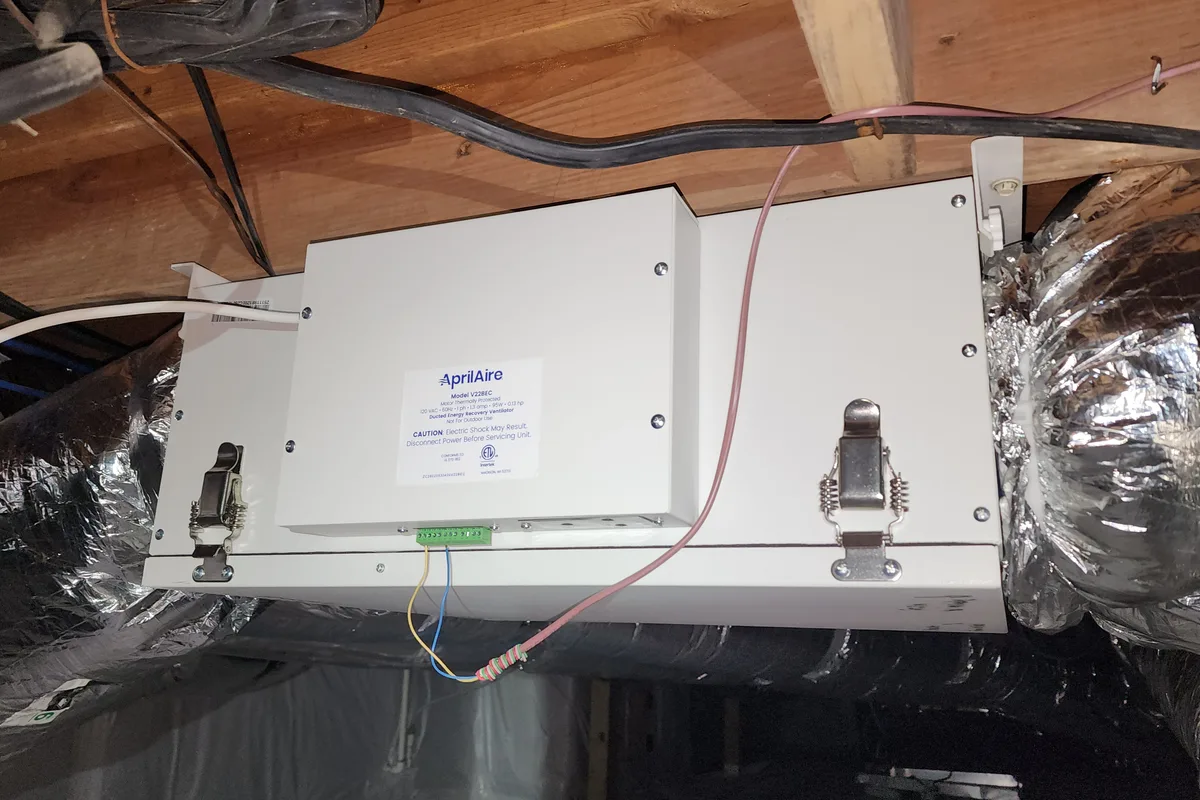
Triangle Dehumidifiers installs AprilAire and Broan ERVs as part of its ERV installation service across Wake County and the Triangle. Here’s what happens between the assessment and the day the system is running.
Step 1: Sizing the System
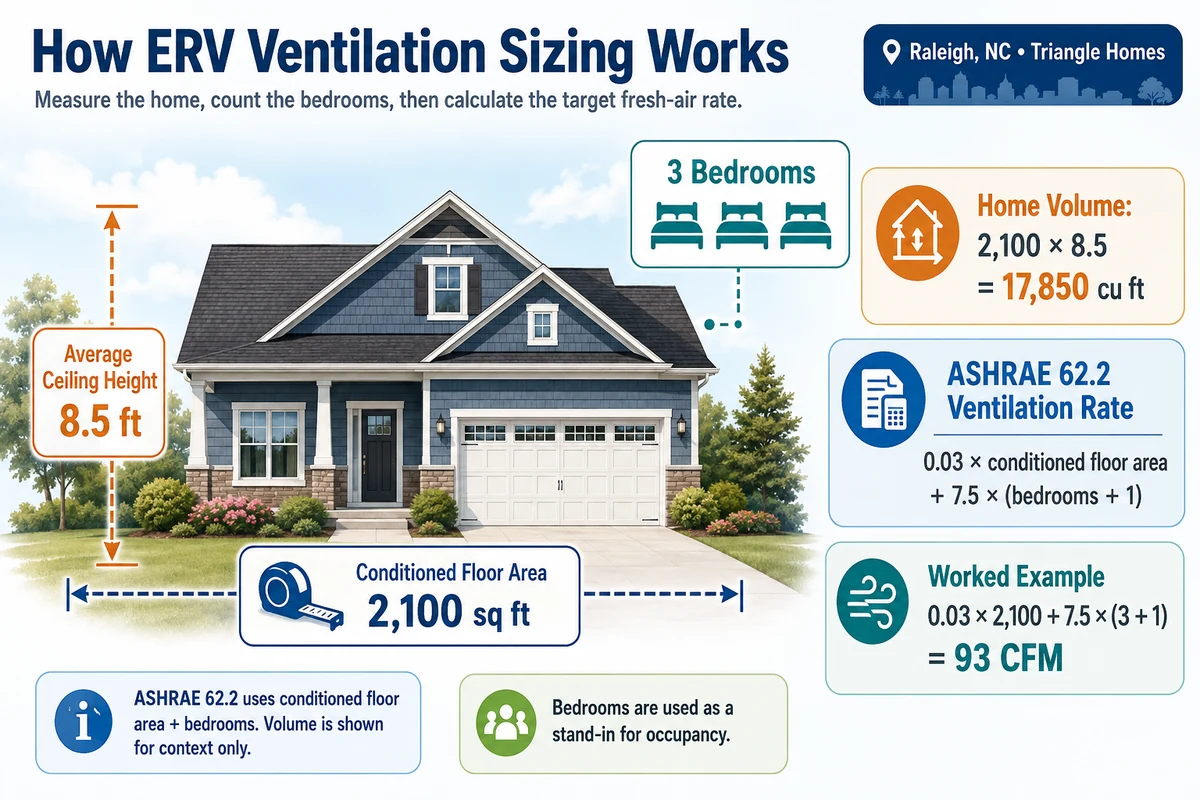
Before anything gets installed, we calculate a target whole-home ventilation rate using the applicable code requirements and ASHRAE 62.2 methodology, then confirm the equipment and duct design can deliver it. The prescriptive calculation is based on conditioned floor area and number of bedrooms, with bedrooms used as a stand-in for assumed occupancy rather than how many people actually live there. Undersize the unit and the home stays stuffy despite having an ERV running.
Oversizing works differently than most people expect. The Broan units we install have adjustable airflow, so a larger unit is not locked into moving more air than the home needs. It gets commissioned to the target rate and runs there, the same as a smaller unit would. What changes is how hard the unit has to work to hit that number. A larger unit running at a lower speed is typically more efficient, and usually quieter, than a smaller unit running near the top of its range. The bigger unit costs somewhat more up front, and the operating cost over the life of the system often runs the other direction.
That puts the sizing decision in a specific order. First we establish the airflow the home actually needs. Then we look at which unit delivers that airflow most efficiently. Sometimes that is the smaller unit and sometimes it is not, and it is worth working through rather than defaulting to the smallest box that meets the number.
The other argument for leaving some capacity in reserve is control. A unit with headroom above the baseline rate can be paired with a wall controller that boosts airflow on demand, which is useful when CO2 climbs with a full house, during cooking or painting, or any time the air needs a faster turnover than the continuous rate provides. A unit sized exactly to the minimum has nothing left to give when you want more. Where that tradeoff lands is one of the things we talk through during the assessment.
This step also confirms whether the home is a good candidate for a standalone ERV or whether pairing it with a whole-house dehumidifier makes more sense. An ERV exchanges stale indoor air for fresh outdoor air. It is not a dehumidifier, and in the Triangle’s climate, most homes still need dedicated humidity control alongside it.
Step 2: Choosing Where the Unit Goes
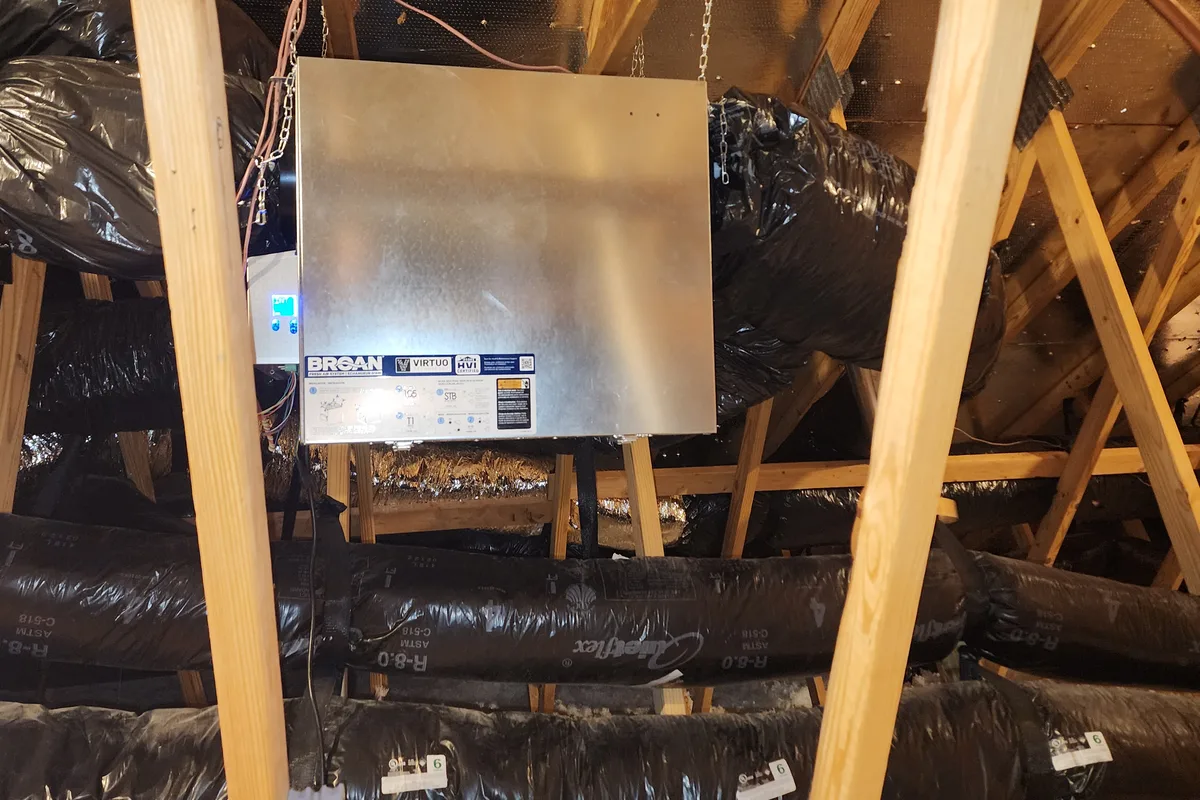
The unit itself typically goes in the attic, an encapsulated crawl space, or a mechanical closet, whichever gives the shortest, most direct path to both an intake and exhaust point on the outside of the home. Attic installations may be feasible when there is a practical route to dedicated, weather-protected exterior intake and exhaust terminations, installed with manufacturer-approved hoods or caps rather than tied into existing roof or gable vents. Crawl space installs work well when the home already has an encapsulated crawl space and the ductwork runs are shorter from below.
The other decision at this stage is duct design: an ERV can use dedicated ventilation ductwork, connect to a compatible HVAC duct system, or use a hybrid of both. Dedicated ducts often give the most direct control over ventilation airflow and where fresh air lands in the home. Tying into existing HVAC ductwork can reduce retrofit work in the right home, but it has to be engineered so the ERV and the air handler’s fan don’t interfere with each other, following the ERV manufacturer’s installation instructions. A home with old, undersized, or hard-to-access ducts is often a better fit for a dedicated run.
Step 3: Running the Intake and Exhaust Ducts
Outdoor intake and exhaust terminations are located according to the selected ERV’s installation instructions and applicable code. The intake has to be kept away from contamination sources like dryer exhausts, plumbing vents, combustion vents, and garage-related pollutants, not just away from the exhaust. Intake and exhaust terminations are also arranged to reduce the chance of exhaust air short-circuiting back into the intake. The ducts get routed to avoid pulling air from the attic or crawl space itself rather than from outside, which would defeat the purpose of bringing in actual fresh air.
Insulated, sealed ductwork matters here more than it does on a typical supply run, since these ducts carry outdoor-temperature air through conditioned or semi-conditioned spaces. Unsealed or uninsulated duct runs lose the benefit of the heat and moisture transfer happening inside the unit.
Step 4: Commissioning and Balancing
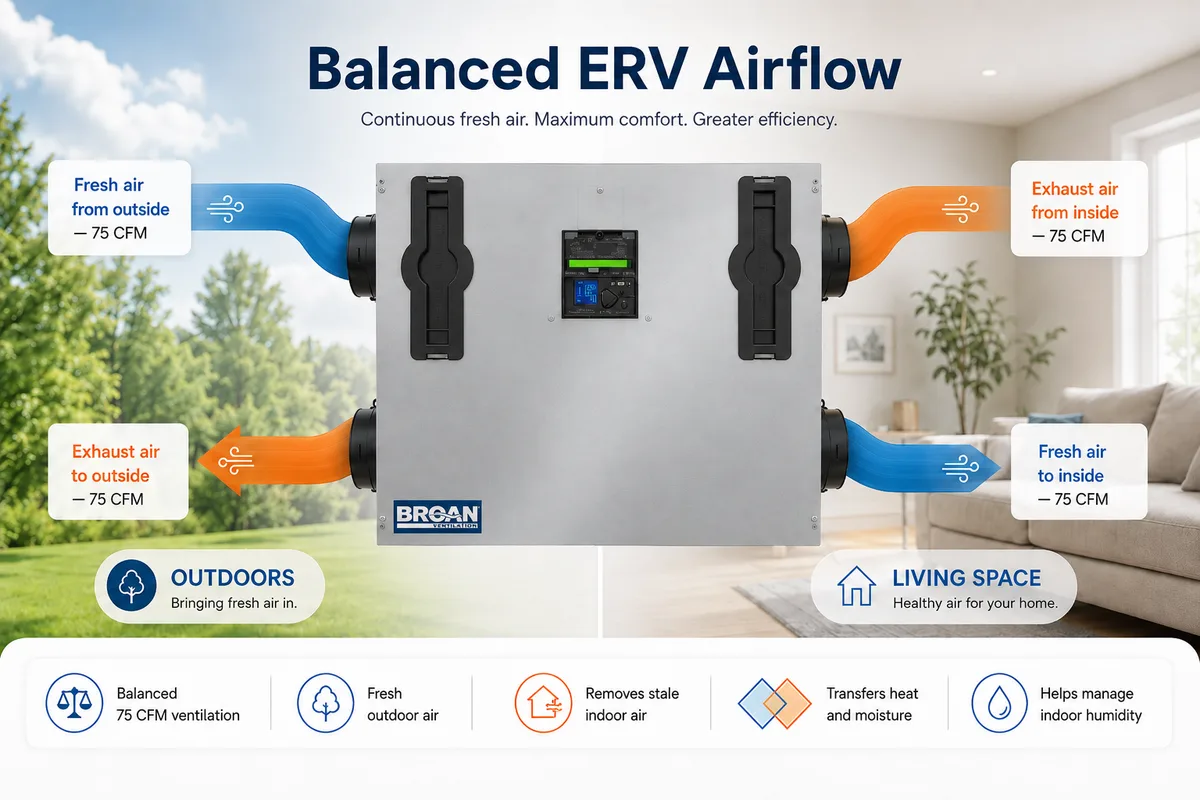
Once everything is connected, the system gets commissioned rather than just switched on. The installer verifies delivered airflow at the intake and exhaust and balances the supply and exhaust sides against the target calculated in Step 1. Additional diagnostic measurements, like static pressure, get used when the duct design or equipment calls for them. An ERV that isn’t balanced, where it’s exhausting more air than it’s bringing in or the reverse, can pull air from places it shouldn’t, including the crawl space or attic.
Step 5: Setting Up Controls and Filters
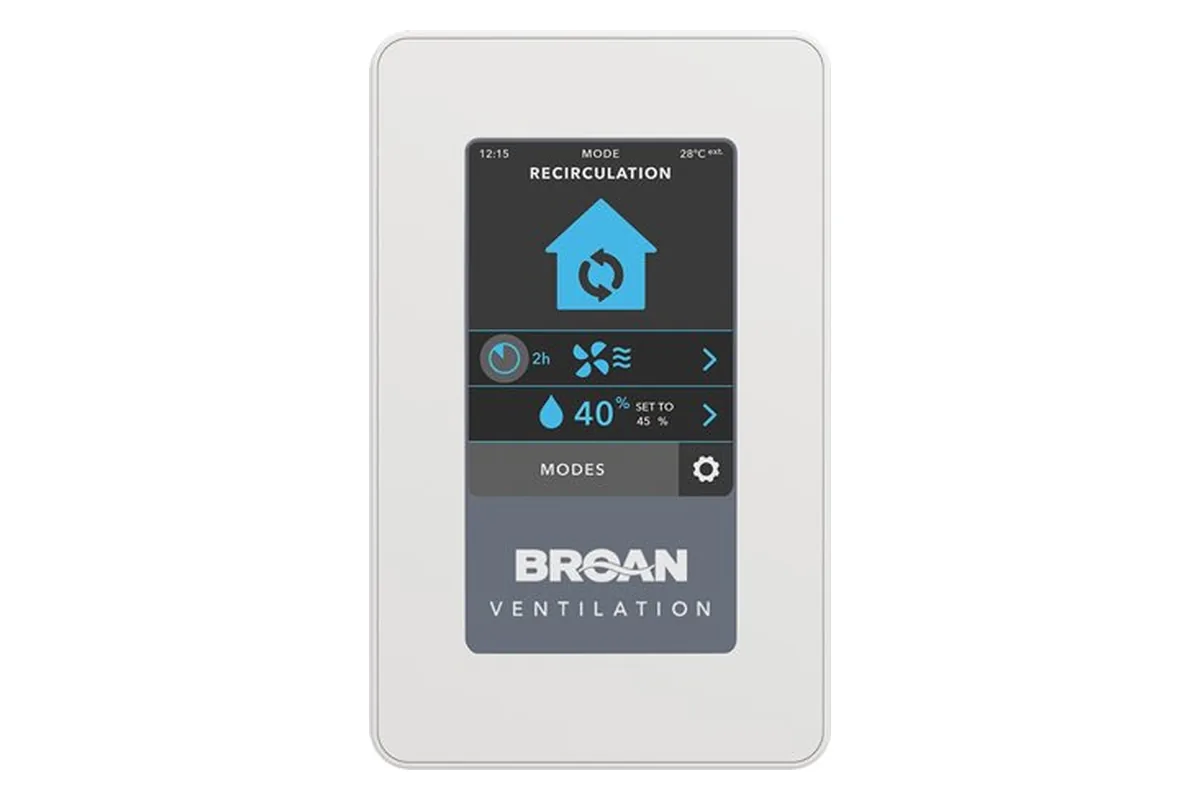
The last step is the control strategy: continuous low-speed operation, timed ventilation on a schedule, or integration with a dehumidifier’s humidity control if the home has one. Which approach makes sense depends on the home and how the homeowner wants to manage it day to day. On Broan systems the day-to-day interface is the VTTOUCHW touchscreen wall control, which shows the current mode, fan speed, and indoor humidity against its setpoint, and is where those settings get changed.
Filter locations get set up to be accessible, since filters should be inspected on the manufacturer’s schedule, commonly every three months, and cleaned or replaced as needed. Service intervals vary by model, filter type, runtime, and indoor conditions. A filter buried behind ductwork that’s hard to reach just means it gets ignored, so accessible placement is part of the install, not an afterthought.
Where a home gets an inline filter box on the fresh-air side, the cabinet itself is built around that same idea. What it gives you:
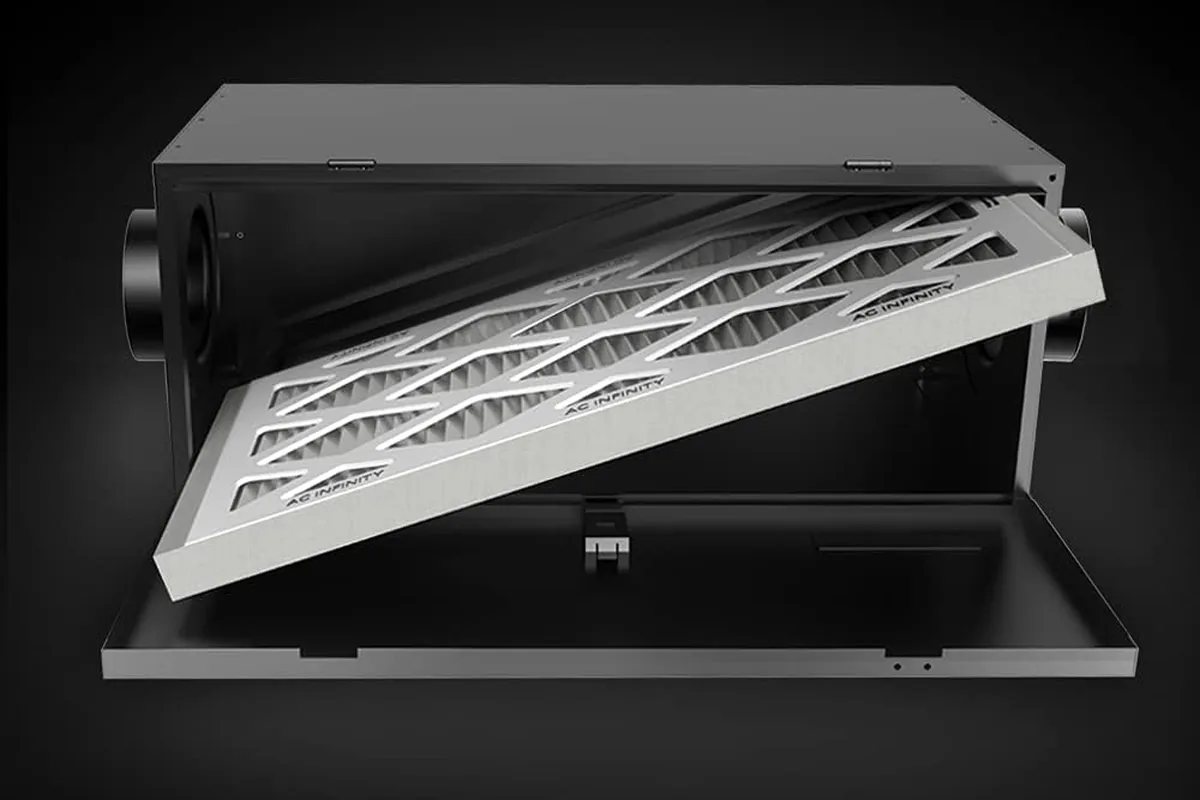
- A slide-lock door. The chamber opens without tools, so a filter swap is a one-minute job instead of a duct disassembly.
- A neoprene layer lining the door. It seals the cabinet closed so unfiltered air and dust can’t bypass the filter around the edges of the door.
- An inner slot that holds the filter. The pleated MERV filter drops into the slot and seats squarely, rather than being wedged in and left to sag.
- Round duct collars on both ends. The box splices directly into the fresh-air run ahead of the ERV, using the same duct diameter as the rest of the run.
- A sealed sheet metal cabinet. It holds up in an attic or crawl space and does not add leakage to a duct run that is carrying outdoor air.
Optional: Better Filtration on the Incoming Air
Every ERV ships with filters, but they are there primarily to keep debris out of the core and the blowers. On most units they are shallow, low-MERV panels. If outdoor air quality is part of why you are installing an ERV, that is worth knowing before the system goes in.
An inline filter box is the upgrade. It is a sheet metal cabinet installed in the fresh-air duct upstream of the ERV, sized to hold a deeper pleated media filter, commonly MERV 11 or MERV 13 depending on the unit and the duct design. Everything the ERV pulls in from outside passes through it before it reaches the core: spring pine and oak pollen, summer haze, smoke that drifts into the Triangle from wildfires, and road dust picked up near the intake.
Two things that gets you:
- Cleaner air into the house. The fresh-air stream is filtered to a real standard before it is delivered, instead of relying on the unit’s built-in panel.
- A cleaner core. The ERV core and blowers stay loaded up with less debris, which means less frequent core cleaning and fewer airflow losses between service visits.
The tradeoffs are straightforward. A deeper filter adds static pressure, so it belongs in the sizing and commissioning math from Step 1 and Step 4, not bolted on after the fact. The cabinet needs physical room in the duct run and has to land somewhere you can actually reach, for the same reason the ERV’s own filters do. And it is one more filter on the maintenance schedule.
If this is something you want, say so during the assessment. It gets designed into the duct layout and quoted with the rest of the system.
For the Tech-Savvy: Remote Wi-Fi Control
The Broan touchscreen wall control runs the ERV locally, and for most homeowners that is all it needs to do. If you already run a smart home and want the ERV inside it, there is a way, but be clear on what it is first: a third-party, open-source project, not a Broan accessory and not a Broan-supported integration.
The short version is that the wall control talks to the ERV over a low-voltage RS-485 connection. A small ESP32 board with an RS-485 interface can speak that same protocol, take the wall control’s place, and put the unit on your Wi-Fi:
ERV → ESP32/RS-485 controller → home Wi-Fi → Home Assistant → phone
A community-maintained ESPHome component, broan_erv_uart, decodes the protocol used by Broan, NuTone, Venmar, and vanEE units, and the repository is where the component code, wiring notes, and example configuration live if you want to build one. The practical compatibility test is whether your unit supports the VTTOUCHW touchscreen control. What it exposes goes well past an on/off switch: operating mode and whether the unit is actually running, supply and exhaust airflow and fan RPM, intake and exhaust temperature, power draw, filter life remaining, fault codes, and remote changes to speed and mode. Home Assistant itself runs on an inexpensive mini PC and gives you one app that can also cover thermostats, CO2 monitors, cameras, and locks, with remote access through Home Assistant Cloud or a VPN like Tailscale.
The tradeoffs are real, and worth understanding before anyone opens the wiring. The ESP32 replaces the wall control rather than joining it, since the ERV firmware only accepts one serial controller, so the touchscreen goes away. And once the ERV has handshaked with the ESP32, that controller has to stay up: if it drops off, the unit can fall into an error state and stop ventilating. That is a meaningful consequence for equipment whose whole job is continuous fresh air. Swapping a factory control for third-party hardware is also worth weighing against your warranty.
If what you actually want is remote on/off or a boost from your phone, a Wi-Fi dry-contact relay on the auxiliary input is far simpler and leaves the factory control in place. The ESP32 route is for people who want real status, airflow data, and automation, and who are comfortable owning the result.
To be direct about our role: this is a homeowner DIY path. We install, size, and commission the ERV itself. We do not install or support the ESP32 setup, and compatibility should be confirmed against your specific unit before the factory control comes off the wall.
How Long It Takes
A straightforward tie-in to existing HVAC ductwork with good attic or crawl space access is the quickest path to a finished install. Homes that need dedicated ducting instead of a tie-in, or that have difficult access, take longer. An in-person evaluation is the best way to get an accurate timeline for your home.
What It Costs
ERV installation in the Triangle typically runs an estimated $5,000–$7,000, depending on unit selection, duct accessibility, and whether the system ties into existing HVAC ductwork or needs its own dedicated ducting. Homes requiring more duct work or harder-to-reach installation locations land toward the higher end.
Is an ERV Enough on Its Own?
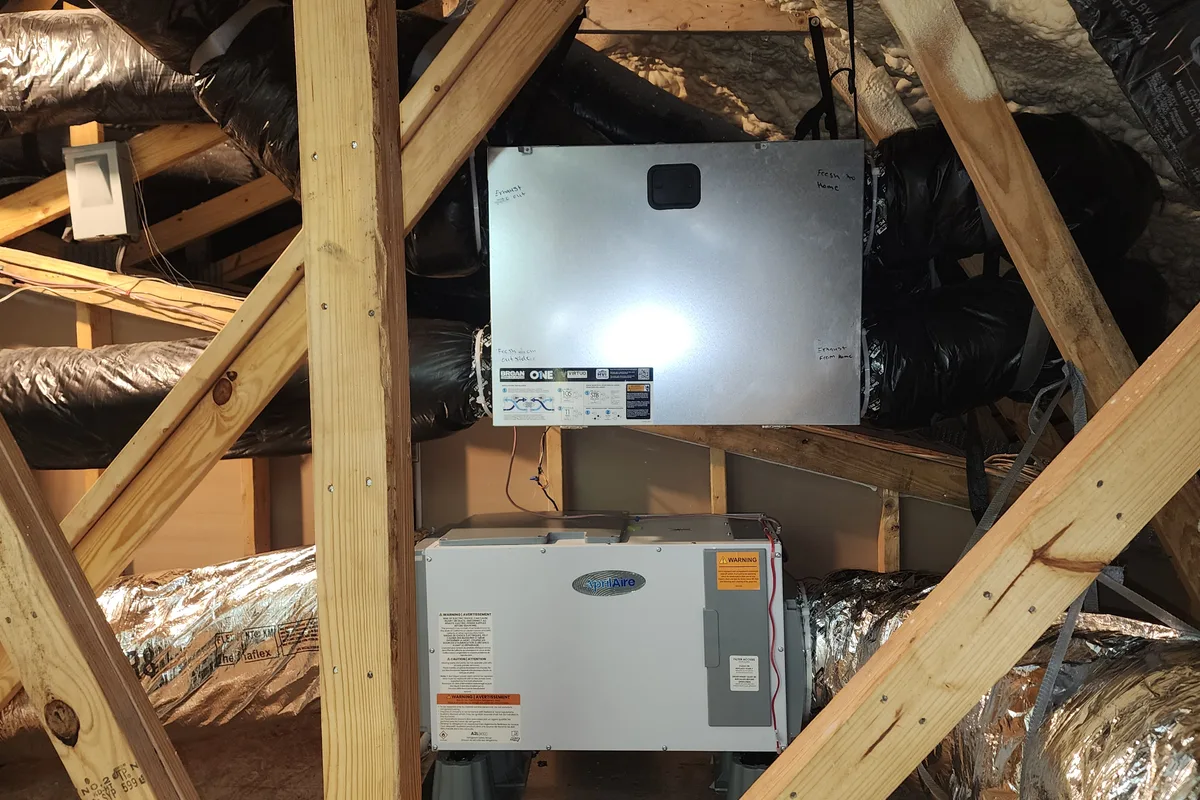
An ERV provides balanced fresh-air ventilation and recovers some heat and moisture between the outgoing and incoming airstreams, but it is not designed to replace a dedicated dehumidifier when the home has a moisture-control problem. In most Triangle homes, especially during the May-through-September stretch when outdoor RH regularly sits at 70–90%, a dedicated dehumidifier is still doing the work of holding indoor humidity at 45–50%. What Is an ERV? Do You Need One? covers how to tell whether an ERV, a dehumidifier, or both make sense for your home, and Indoor Air Quality for NC Homes breaks down the fuller picture of what builds up in a sealed home’s air.
Frequently Asked Questions
How long does ERV installation take?
Installation time depends on whether the ERV ties into existing HVAC ductwork or needs dedicated ducting, and on how accessible the attic or crawl space is. An in-person evaluation gives an accurate timeline for your home.
Where does an ERV get installed in a Triangle home?
Most commonly the attic or an encapsulated crawl space, depending on where the home's ductwork runs and which location gives the shortest, most direct duct path to both an outdoor intake and exhaust point. A mechanical closet is also an option in some homes.
Does an ERV tie into my existing HVAC ductwork?
An ERV can tie into a compatible HVAC duct system or run on dedicated ventilation ductwork, and both are legitimate approaches. Dedicated ducts give more direct control over airflow and where fresh air is delivered. Tying into existing HVAC ductwork can work well in the right home, but it has to be designed so the ERV and the air handler's fan don't interfere with each other. Which fits your home gets evaluated during the assessment.
Can you add better filtration to the fresh air an ERV brings in?
Yes. An inline filter box installed in the fresh-air duct upstream of the ERV holds a deeper pleated media filter, commonly MERV 11 or MERV 13, so incoming outdoor air is filtered before it reaches the ERV core and the home. It is optional, and because the added filter increases static pressure it has to be included in the sizing and commissioning rather than added afterward.
How much does ERV installation cost in the Triangle?
ERV installation in the Triangle typically runs an estimated $5,000–$7,000, depending on unit selection, duct accessibility, and whether it ties into existing HVAC ductwork or needs dedicated ducting. An in-person evaluation gives an accurate number for your home.
Considering Fresh-Air Ventilation for Your Home?
Every home’s ductwork and attic or crawl space access is a little different, and that’s what determines the real scope of an ERV install.
Triangle Dehumidifiers, LLC provides free evaluations throughout Wake County and the Triangle. We’ll look at your ductwork, sizing needs, and current indoor air quality, then give you a written quote for exactly what your home needs.
Call or text us at (919) 867-0580 — or request your free evaluation online. We serve Raleigh, Cary, Apex, Holly Springs, Fuquay-Varina, Garner, Wake Forest, Knightdale, Morrisville, Durham, and Chapel Hill.