Table of Contents
It’s the Same Reason a Glass of Iced Tea Sweats

A wall or ceiling sweats when its surface is colder than the dew point of the air touching it. In the Triangle’s warm, humid months, that takes two things. The indoor air is holding more moisture than it should, usually an indoor dew point above about 60°F. And something in the house is being chilled below that, which in an air-conditioned home is often a metal register or boot, glass, or, in some cases, nearby drywall. Lower the humidity enough and the sweating typically stops everywhere at once.
Triangle Dehumidifiers, LLC is a whole-house and crawl space dehumidifier company in Holly Springs, NC, serving Wake County and the Triangle. For homes in Raleigh, Cary, Apex, and Holly Springs, issues such as water beading on the ceiling near air vents, mildew spots on ceilings and upper walls, and damp corners in closets can arise, even when the air conditioner is running and cooling normally. The cause is often the moisture load, and this past summer’s weather may have pushed houses that were already close to the line over it. Stains and damp spots from the summer can linger, because warm, humid days are still common in the Triangle in September and the air conditioner is still running.
Dew Point Is the Place to Start
Relative humidity tells you how full the air is. Dew point tells you the surface temperature at which that air can start giving up water. Condensation forms only on a surface at or below the dew point, so dew point is the right number to start with. It is a starting measurement, not a diagnosis by itself.
This table shows the approximate indoor dew point for a house held at 75°F, calculated with the standard psychrometric formula and rounded to the nearest degree.
| Indoor RH at 75°F | Approx. dew point | Meaning |
|---|---|---|
| 45% | 52°F | Low condensation risk for typical indoor surfaces. Verify unusually cold registers or pipes. |
| 50% | 55°F | Usually safe, but a register or boot colder than 55°F can still sweat. |
| 55% | 58°F | Condensation becomes possible on cold metal registers, boots, pipes, or poorly insulated components. |
| 60% | 60°F | Higher risk where a measured surface is 60°F or colder. |
| 65% | 62°F | High risk for cold HVAC components. Investigate ducts, grille temperature, and moisture sources. |
| 70% | 65°F | Elevated risk, but condensation still occurs only on surfaces at or below 65°F. |
Room humidity alone doesn’t tell you whether a surface will sweat. It has to be at or below the dew point, so a cold register can sweat at a lower dew point than a warm wall. The difference between low and high condensation risk is only about ten degrees of dew point, roughly the gap between 45% and 65% RH. A house held at 45–50% RH has a dew point in the low to mid 50s, at or below the temperature of most surfaces in the living space. That is why Triangle Dehumidifiers targets 45–50% RH, in line with the EPA’s guidance to keep indoor humidity below 60%, ideally 30–50%.
Where the Cold Surfaces Come From
In an air-conditioned house, the coldest surfaces are the ones the cooling system makes.
Supply air and the ceiling around registers
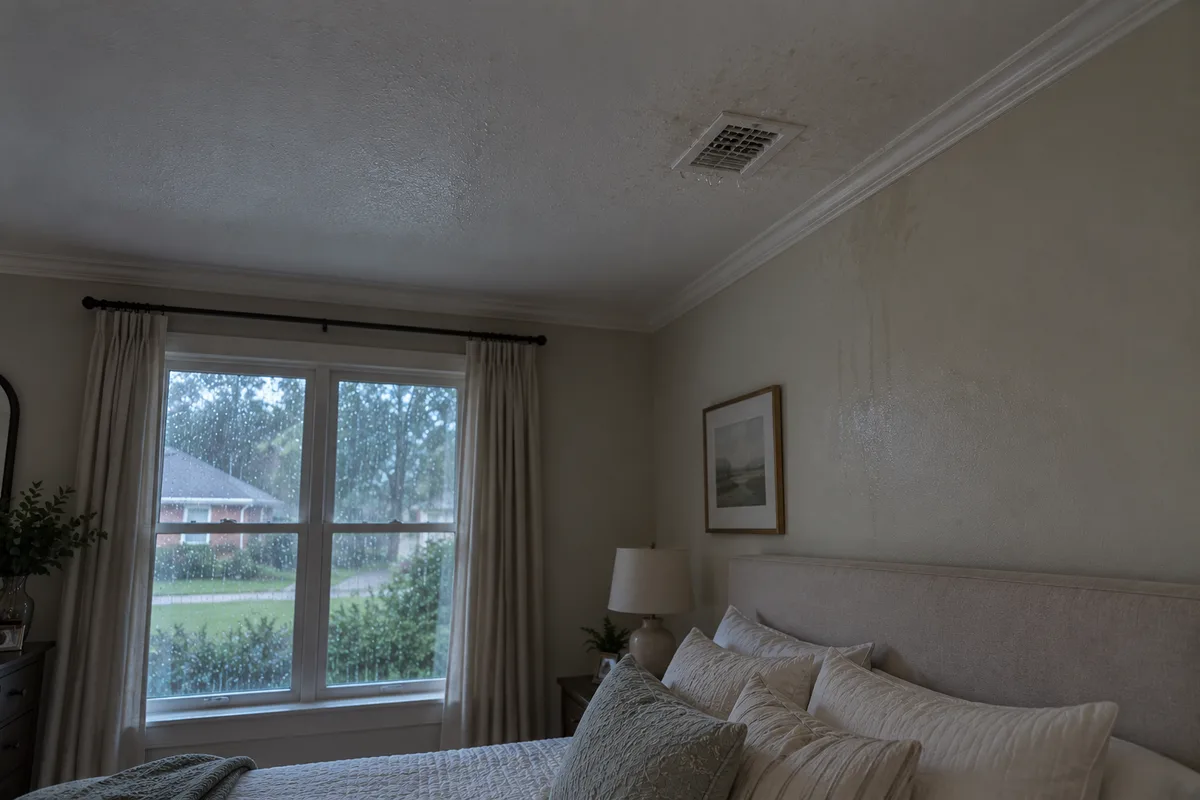
As building science engineer Allison Bailes explains in his piece on why air conditioning vents sweat, air leaving a cooling coil is usually about 55–60°F, and “Condensation occurs only when humid air is in contact with a cold surface.” The register face and metal boot can become much colder than the room air while the system runs. In some installations, cold supply air or thermal bridging can also cool a nearby patch of ceiling drywall enough to raise its surface humidity or, in severe cases, cause condensation. Measure the surface temperature rather than assuming the drywall is at supply-air temperature. Airflow direction matters too. Cold air can hug the ceiling as it leaves a ceiling register (the Coanda effect), which can chill a stripe of drywall downstream of the vent, and mildew can show up there later.
A sweating register is often a sign of humid room air more than a duct defect, because the register is doing its job. Damp drywall nearby is less clear-cut, so check the temperature of the surface itself and look above the ceiling before deciding what is causing it.
Attic ducts, boots, and leaks
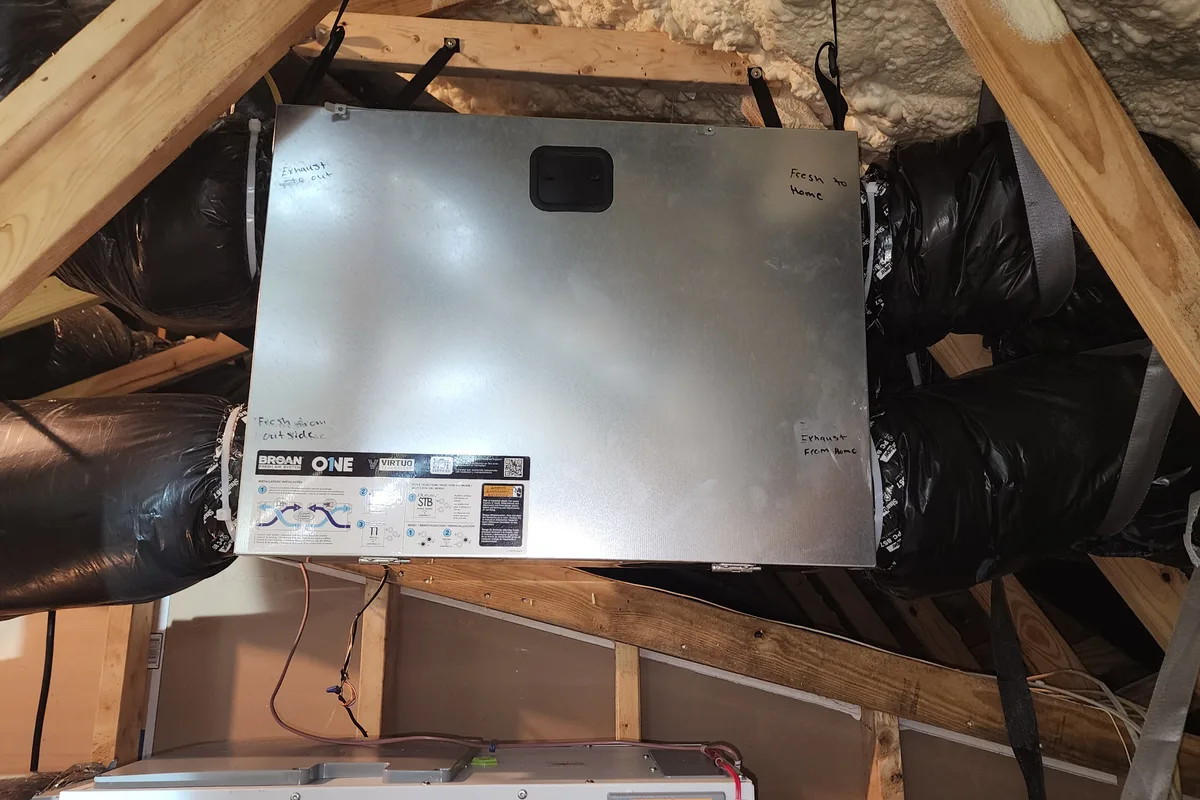
Some Triangle homes, especially newer two-story houses, have the air handler or much of the ductwork in a vented attic. On a hot, sunny afternoon that attic can be well over 100°F, and its air carries the outdoor dew point, which can reach the upper 60s to low 70s°F on humid days. A supply boot sitting in that air at 58°F is far below the attic dew point, so it can sweat on the attic side. The water can run down the boot, soak the drywall around the register from behind, and show up as a tan or yellow ring on the ceiling. Uninsulated or poorly insulated flex duct can do the same and drip onto the ceiling below.
Return leaks can be worse for the whole house. A leaky return duct in a hot attic or crawl space can pull humid air into the system on every cycle, which can raise the humidity in the rooms it serves. Bailes described a Georgia house with sweating vents where humid outdoor air was getting into what was supposed to be a sealed attic through gaps, with duct leakage and a bath fan pulling it in.
Walls: wet cladding, cool drywall
Exterior walls are usually warm during the cooling season, so they rarely sweat on the room side the way ceilings near registers do. When one does get damp, look behind furniture and in closets, where air barely moves and the surface can sit a few degrees cooler than the room. At 65–70% RH that can be enough for mildew.
Rain-soaked brick, stucco, or fiber cement can also push moisture inward when the sun heats it, toward the cooler, air-conditioned drywall. Joseph Lstiburek of Building Science Corporation describes that setup in BSI-061 as “hot wet cladding, cold interior,” and calls it “not a good combination.” A wet July followed by a hot August, like this year’s, can set a house up for exactly that.
Other places
The same rule explains water beads on toilet tanks, cold-water pipes, and other cool surfaces. Some homeowners also see moisture on the glass of a sealed gas fireplace. If that keeps happening, have the fireplace serviced, since gaskets and venting can play a part too. Anything colder than the dew point of the air touching it gets wet.
How Summer 2026’s Weather Set the Stage
The weather did two opposite things in a row, and each one was hard on humidity in its own way.
July was the second-wettest July on record in Raleigh, with 12.16 inches of rain, more than the first six months of the year combined, according to the North Carolina State Climate Office. Rain like that can soak the Piedmont clay, fill vented crawl spaces with damp air, and load moisture into brick, siding, and framing. July also included a cloudy, wet, unseasonably cool spell in the last week, when Raleigh’s high on July 23 was only 74°F, a record-cool high for the day. On a rainy 76°F day a house needs very little cooling, so the air conditioner runs only a few minutes an hour. That limits how much moisture the coil can drain away, and indoor humidity can drift up to 65–70%. Our post on why the house feels muggy with the AC on covers that part, and why your AC isn’t removing humidity explains why short cooling cycles do so little.
Then August turned hot. The same office reports Raleigh had its fourth-warmest August on record, with only 1.21 inches of rain. Air conditioners that had been cycling briefly in the cool, wet stretch could go to running for hours, which keeps registers, boots, and the ceiling around them cold for long stretches, while the house and crawl space may still have been giving back moisture from July. A high indoor dew point plus cold surfaces is the condensation equation, and some houses ended up on the wrong side of it.
Homes that keep their indoor dew point in the 50s tend to stay dry through weather like this, whether the air conditioner does the drying or a dehumidifier does.
Summer is winding down, but the problem doesn’t end with it. Warm, humid days are still common in the Triangle in September, and mild, rainy fall days set up the same trap as the rainy, mild days in late July: the air conditioner barely runs, so it can’t dry the house. If ceilings or walls sweated this summer, or you found stains or mildew that weren’t there before, now is a good time to find the cause.
Mildew Can Start Before You See Any Water
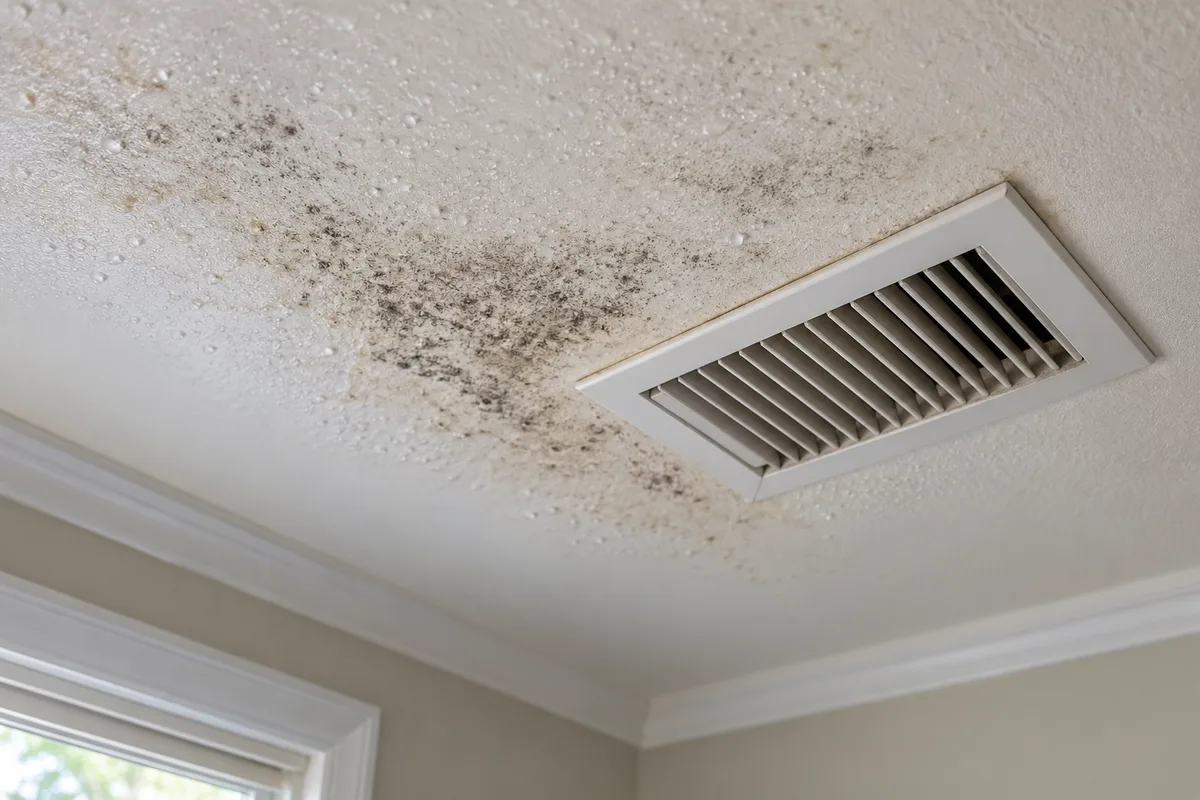
A ceiling doesn’t have to drip to grow mildew. The air touching a cool surface is more humid than the air in the middle of the room, because it has been cooled without losing any moisture. In a 75°F room at 55% RH, which sounds harmless, the air touching a 60°F patch of ceiling is at about 92% RH. At 65% RH in the room, a 62°F patch reaches 100% and is wet.
ASHRAE Standard 160, the building industry’s moisture-design standard, originally used a conservative design limit of 80% surface humidity averaged over 30 days, and has since added a more detailed mold-growth model. Either way, sustained high surface humidity can be enough for mold to grow on drywall paper and the dust on paint without any liquid water.
That is why the first sign in many homes isn’t a drip. It’s a faint gray haze on the ceiling downstream of a vent, black spots in an upper corner, or a musty smell in a closet on an exterior wall. Our list of five humidity warning signs covers the rest of the pattern.
How to Tell Condensation From a Leak
Condensation and leaks get treated very differently, so it is worth taking the time to narrow down which one you have.
- Timing. Condensation more often tracks indoor dew point, air conditioner runtime, and cold surfaces. It tends to be worst on humid mornings and during long cooling runs, and it can ease when the house dries out. A roof leak often tracks rain, wind, or roof wetness, and plumbing leaks may track fixture use. These patterns are clues, not proof.
- Pattern. Condensation lands on the coldest surfaces, like register faces, the ceiling around vents, duct boots, and cold pipes, and tends to be spread out and beaded. A leak follows a path from a source, stains in a defined shape, and often comes with bubbling paint or soft drywall.
- Measurement. A hygrometer gives you room temperature and RH, and any dew point calculator turns those into a dew point. An infrared thermometer pointed at the wet spot gives the surface temperature. If the surface is at or below the measured indoor dew point, room-side condensation is possible. Confirm the source by checking timing, the area above or behind the surface, duct and boot conditions, plumbing, roof penetrations, and whether the wetting persists when indoor humidity is lower.
- Color. Clear beads are usually condensation. Tan, brown, or clear drips on a painted wall that feel glossy or soapy can be surfactant leaching, where moisture pulls water-soluble ingredients out of latex paint. Sherwin-Williams says it “can look like tan, brown or clear spots or paint streaks” and that it washes off with soap and water. It means moisture is sitting on that wall, but a leak can cause it too, so check the source.
- Location. Water that shows up on the room side of the drywall near a register may be indoor air condensing. A ring stain that spreads outward from the register, with a damp boot above it, may be attic air condensing on the duct. Both point to humidity on different sides of the ceiling, but a hidden leak, condensate line, or duct problem can look the same, so check above and behind the ceiling.
If you can’t tell, or the drywall is soft, treat it as a leak until a professional rules one out. Water damage from a leak is a different repair than a humidity problem.
How to Stop Walls and Ceilings From Sweating
Work through these in order.
Measure first. Put a hygrometer where the problem is and one on another floor. If the readings sit above 55% RH with the air conditioner running, humidity is very likely part of the problem, whatever else is going on. Treat dew point as the place to start, not a diagnosis by itself, and still check the ducts, attic, plumbing, and roof.
Cut moisture at the source. Run bath fans for about 20 minutes after showers, use the range hood when cooking, and vent the dryer outdoors. If the crawl space is wet, that can matter most. Vented crawl spaces in the Triangle commonly run 70–85% RH in summer, and that air can move up through the floor into the house. Our post on why crawl spaces stay wet all summer here explains why, and a crawl space dehumidifier addresses that source directly.
Have the ducts and AC checked. Leaky returns and uninsulated boots are duct and HVAC work, so ask an HVAC contractor to seal and insulate them and to review the fan, airflow, and dehumidification settings against the manufacturer’s guidance. Set the fan to AUTO rather than ON if humidity is a concern, since a fan that keeps running after the compressor stops can re-evaporate some condensate into the supply air. Our post on why your AC isn’t removing humidity covers those settings. If you aren’t sure whether your ducts leak, Peak Energy, Inc. offers duct leakage testing to find where the leaks are, and an HVAC contractor can then seal them. Peak Energy is our sister company.
Don’t count on the thermostat. Lowering the setpoint isn’t a dependable fix. The system runs longer, which can pull out some extra moisture, but it also cools the room and everything in it. Supply air temperature is set mostly by the coil and airflow, not the thermostat setting, so a lower setpoint doesn’t make the register any warmer.
Add a whole-house dehumidifier when the AC can’t get there. If the measurements point to high indoor humidity, this is often the practical answer. A whole-house dehumidifier installed at the air handler runs on its own humidity setpoint, independent of the thermostat, so it can keep removing moisture on the rainy 76°F days when the air conditioner barely runs. When it holds the house at 45–50% RH, the indoor dew point drops into the low to mid 50s, and most ceilings and registers should stay above it. Triangle Dehumidifiers, LLC installs AprilAire whole-house dehumidifiers ducted into the existing supply system. Installed cost runs an estimated $4,500–$5,500 for a standard integration, or $5,000–$7,000 when the HVAC setup needs additional ductwork or electrical. It does add a small amount of heat to the air, which the air conditioner then removes, and the Building America Solution Center notes this makes the air conditioner “run a little bit longer, which will dehumidify the air even more.” It will not fix a roof leak, dry a wet attic, or stop water between window panes, so the measurement step comes first.
If you are also seeing water on window glass, our post on condensation on windows in summer explains how to tell interior condensation from harmless exterior dew.
Frequently Asked Questions
Why are my walls and ceilings sweating?
A wall or ceiling sweats when its surface is colder than the dew point of the air touching it. In the Triangle's warm, humid months that usually means indoor air at 60–70% relative humidity (a dew point of about 60–65°F at 75°F) meeting a surface the air conditioner has chilled, most often a supply register or duct boot, and sometimes the drywall around them. Drying the indoor air to 45–50% RH drops the dew point to roughly 52–55°F, at or below the temperature of most surfaces in an occupied house, which makes sweating far less likely.
Why is there condensation on my ceiling around the AC vents?
Air leaving the cooling coil is about 55–60°F, and the register face and the metal boot behind it can become much colder than the room air while the system runs. If the indoor dew point is above the temperature of one of those surfaces, water can condense there first. A 75°F room at 65% RH has a dew point of about 62°F, so a register surface at 58°F would likely sweat while the system runs. Nearby drywall is less predictable, so it is worth measuring its surface temperature. A brown or yellow ring around a register can also mean humid attic air is condensing on the cold boot above the ceiling and dripping onto the drywall from behind.
What humidity level causes condensation on walls and ceilings?
It depends on the surface temperature, which is why dew point is the number to watch. At 75°F indoor temperature, 50% RH gives a dew point of about 55°F, 60% RH about 60°F, and 70% RH about 65°F. Any surface colder than the dew point gets wet. Supply registers and boots can run at or near the 55–60°F supply air temperature, so condensation risk on them climbs quickly above roughly 55–60% RH, and a surface colder than that can sweat at lower humidity. The EPA recommends keeping indoor humidity below 60%, ideally 30–50%. Triangle Dehumidifiers targets 45–50% RH.
Can mildew grow on a ceiling without visible condensation?
Yes. The thin layer of air against a cool surface is more humid than the middle of the room. If a room reads 75°F and 55% RH, the air touching a 60°F patch of ceiling is at about 92% RH, with no liquid water anywhere. ASHRAE Standard 160, the building industry's moisture-design standard, originally used a conservative design limit of 80% surface humidity averaged over 30 days, and has since added a more detailed mold-growth model. Either way, sustained high surface humidity can be enough for mold to grow on materials like drywall paper, which is why mildew often shows up near registers and in corners before anyone sees a drop of water.
How do I stop condensation on my walls?
Lower the indoor dew point, warm the surface, or both. Start by measuring with a hygrometer in the room and an infrared thermometer on the wet spot. Then run bath and kitchen exhaust fans, set the AC fan to AUTO, have an HVAC contractor look at duct leaks and cold duct boots, and address a wet crawl space if it is feeding moisture into the house. If the air conditioner cannot hold the house under 55% RH on its own, a whole-house dehumidifier is often the direct fix. Lowering the thermostat is not a dependable fix, because it cools the room and its surfaces along with the air.
Will a whole-house dehumidifier stop my walls and ceilings from sweating?
When the cause is high indoor humidity, it usually does. A whole-house dehumidifier installed at the air handler runs on its own humidity setpoint, independent of the thermostat, and, when sized for the home, can hold the house near 45–50% RH even on rainy, mild days when the air conditioner barely runs. That drops the indoor dew point to the low to mid 50s, below the temperature of most registers, ceilings, and walls. In the Raleigh area the installed cost is typically $4,500–$5,500 for a standard integration, or $5,000–$7,000 for a more complex one. It will not fix condensation caused by a leak, humid attic air on the back side of the ceiling, or water between window panes.
Sweating Ceiling? Find Out Whether It’s the Air or the Roof.
The measurements that help tell a humidity problem from a leak take about twenty minutes: indoor temperature and RH, the dew point they add up to, and the temperature of the wet surface. Triangle Dehumidifiers, LLC in Holly Springs, NC provides free in-home humidity evaluations throughout Wake County and the Triangle. We’ll measure your indoor dew point, check the surfaces that are sweating, look at the crawl space, and tell you whether a whole-house dehumidifier or a crawl space dehumidifier is the right fix, or whether something else, like duct leaks or a roof leak, needs to be handled first.
Call or text us at (919) 867-0580, or request your free evaluation online. We serve Raleigh, Cary, Apex, Holly Springs, Fuquay-Varina, Garner, Wake Forest, Knightdale, Morrisville, Durham, and Chapel Hill.