Table of Contents
Does AC Remove Humidity?
An air conditioner removes moisture only as a side effect of cooling. Net moisture removal can be reduced by short cooling cycles, excessive airflow across the coil, and fan operation that continues after the compressor stops. Get enough of those wrong and a system can cool a house effectively while barely drying it. That is the situation in a lot of Triangle homes right now.
It’s been a wet, sticky summer. Raleigh had its second-wettest July on record and one of its warmest Augusts, according to the North Carolina State Climate Office, and Triangle Dehumidifiers, LLC in Holly Springs, NC has spent the season taking calls from homeowners in Cary, Apex, Holly Springs, and Raleigh whose thermostats read 74°F while the hygrometer reads 65–70% RH. Most of those homes don’t have a broken air conditioner. They have one that’s oversized, single-stage, was never wired for humidity control, or has the fan set up to undo its own work. Often it’s more than one of those at once.
Our post on why the house feels muggy with the AC on covers the moisture load side. This one covers the equipment side: why cheap single-stage systems don’t dehumidify, and what actually decides whether a home stays comfortable or stays sticky.
How an Air Conditioner Dries the Air
Cooling and drying are the same event at the coil. Return air at 75°F passes over an evaporator coil that is well below the dew point of that air, so water vapor condenses on the fins the same way it does on a glass of iced tea. That water runs down the coil into the drain pan and out the condensate line. What leaves the coil is supply air that is colder and drier than what came in.
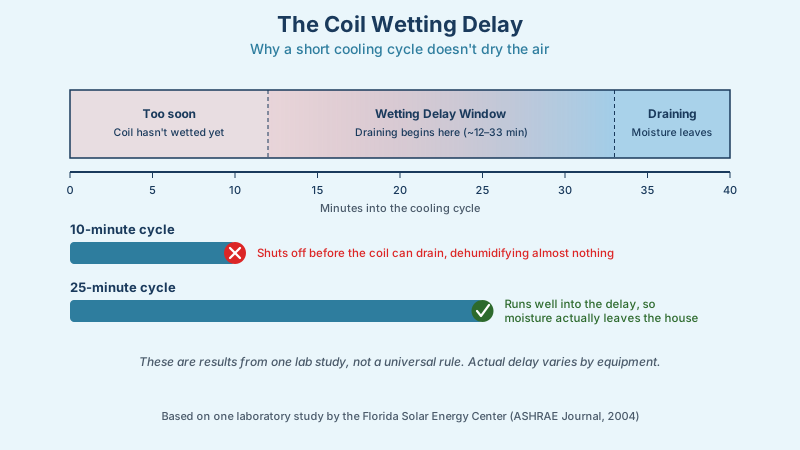
The catch is what happens to that moisture before it actually drains. Water condensing on the coil doesn’t run off right away, it clings to the fins until enough builds up to fall into the drain pan. In one laboratory study, researchers at the Florida Solar Energy Center found this took roughly 12 to 33 minutes of steady cooling depending on conditions, faster on a muggier day, slower on a drier one. That’s a finding from one study, not a universal number for every system, but the underlying mechanism is well established: while that water sits on the coil instead of draining away, it’s vulnerable to evaporating back into the supply air, particularly if the blower keeps running after the compressor shuts off.
That’s why a short cooling cycle can end up removing very little moisture on net, even though the coil is condensing water out of the air the whole time it runs. Whatever gets captured has to actually drain away to count, and a cycle that shuts off too soon doesn’t give it the chance. A system running 10-minute cycles spends most of its time in that in-between state; one running 25-minute cycles spends most of its time past it, with water actually leaving the house instead of evaporating back in.
Why Oversized, Single-Stage AC Doesn’t Dehumidify
An oversized single-stage air conditioner satisfies the thermostat too fast to dry the air. It hits the temperature setpoint in eight or ten minutes, shuts off, and leaves behind a coil that never got past the wetting delay. The Building America Solution Center puts it plainly: “In homes with over-sized air conditioners, the thermostat quickly reaches the desired set point before moisture can condense on the coil and be removed from the home.”
Oversizing is common around here. Tonnage often gets picked by square footage instead of a proper room-by-room load calculation, so the system ends up with a lot more cooling power than the house actually needs except on the hottest afternoons. Industry sizing guidelines only allow a small amount of that kind of oversizing, and for good reason: a modulating system can throttle itself back to match the load, but a single-stage unit can’t. It’s either running full blast or it’s off.
The worst days for humidity actually aren’t the hottest ones. On a 95°F July afternoon, even an oversized system runs long enough to pull out plenty of water. It’s the cloudy, rainy 78°F days, when the air outside still feels heavy but it’s not really hot, that cause trouble. The house barely needs any cooling, so the system runs just a few minutes an hour, and indoor humidity creeps up to 65% or higher even though the thermostat looks perfectly comfortable. Building scientists have documented this same pattern for years, especially in newer, more efficient homes, which is one reason new homes here often need dehumidifiers even though they’re built tighter and better insulated than older ones.
Airflow matters too. Too much air moving across the coil keeps it warmer, which cools the air fine but doesn’t dry it nearly as well. A basic single-speed blower usually can’t be dialed back far enough to fix that without starving the coil the rest of the time.
Airflow Has to Be Measured, Not Guessed At
Two things decide whether the coil runs cold enough to actually dry the air: how much air is moving across it, and how hard the blower has to work to push that air through your ductwork. Neither one should be a guess.
Airflow is set at the air handler itself, and it should be checked with a meter after the ductwork is connected, not just assumed. For our humid climate, the sweet spot is around 350–370 CFM of airflow for every ton of cooling capacity. Go much lower and the coil can freeze up; go much higher, which is common on builder-grade systems, and the system dries the air poorly. It’s one setting, and in a lot of the Triangle homes we see, it’s wrong.
The other factor is how hard the blower has to strain to push air through your ducts, sometimes called static pressure. Residential blowers are only rated to work against so much resistance, and it’s easy to exceed that without realizing it: an undersized return, a clogged filter, closed dampers, or crushed flex duct in the attic can all choke off airflow. When that happens, the blower either works harder and louder to compensate, or it just moves less air than it’s supposed to, and either way the coil isn’t getting the airflow it needs to dry the house properly. A technician can measure total external static pressure and cross-reference it against the blower’s published performance data, or use another approved method, to verify actual airflow during installation or a service call, and it’s a fair thing to ask for.
AC Fan: AUTO Is Usually the Better Setting
Set the fan to AUTO rather than ON if humidity is a concern. Running the blower after the compressor shuts off blows air across a coil that’s still wet, which can re-evaporate some condensate into the supply air. Building science engineer Allison Bailes tested this in his own house: switching his fan from AUTO to ON pushed his indoor humidity from about 58% up to 70% within just a few days.
A related setting is the fan-off delay: many systems are set at the factory to keep the blower running for a minute or two after every cooling cycle, which is meant to squeeze a little extra efficiency out of the system, but can do it by re-evaporating some of that condensate back into the supply air. Whether that’s worth changing depends on the equipment and its manufacturer-approved control sequence. Ask a technician to review the manufacturer-approved fan-off-delay and dehumidification settings for your specific system. Some equipment has a dedicated coil-drain or dehumidification mode built in rather than a simple delay setting.
Blower Ramp Profiles Vary by Equipment
Some higher-end air handlers use a blower profile that ramps the fan speed up at the start of a cooling cycle and back down at the end, aimed at quieter, more efficient operation. How that ramp behaves, and what it does to humidity, depends on the manufacturer, the specific air handler model, the thermostat it’s paired with, and which mode is selected. In general, a slow ramp-up can help humidity by letting the coil get cold and wet faster, while a ramp-down that keeps the fan running at reduced speed after the compressor shuts off can re-evaporate some of the moisture the coil just collected.
Because these profiles are proprietary and vary between brands, the right move is to have a technician pull up the specific settings for your equipment and confirm which profile is active and whether a dehumidification-friendly option is available, rather than assuming one universal fix applies.
How to Tell Whether This Is Your Problem
- A hygrometer in the living space reads above 55% while the air conditioner is running. The EPA recommends keeping indoor humidity below 60%, and mold risk starts climbing above that.
- If you time a cooling cycle and it’s under about 12–15 minutes, the system probably isn’t running long enough to actually dry the air, even though it’s cooling it just fine.
- The thermostat fan is set to ON or to a “circulate” schedule.
- The thermostat has no humidity reading and no dehumidify setting.
- Supply registers, the supply plenum, or exposed ducts sweat. Metal that cold in air that wet points to a humidity problem and, often, an airflow problem at the same time.
- The house is worse on rainy 75–80°F days than on sunny 95°F days.
If three or more of those describe your house, the air conditioner is not going to fix itself with a filter change. Our list of humidity warning signs covers what the moisture is doing to the house in the meantime.
The Direct Fix: A Whole-House Dehumidifier
If your HVAC company is already out for a service call, or you’re shopping for a new system anyway, it’s worth asking about everything covered above: fan set to AUTO, fan-off-delay and dehumidification settings reviewed against manufacturer guidance, and airflow measured instead of assumed. Those are legitimate fixes, and cheap when they’re already on the table.
But settings only go so far. An oversized single-stage system can’t be adjusted into a modulating one, and a system that’s cooling the house just fine and isn’t due for replacement doesn’t need to be torn out over a humidity problem. That describes most of the homes we see: a working air conditioner that simply can’t hold humidity down on its own, especially on the mild, rainy days when it barely runs at all.
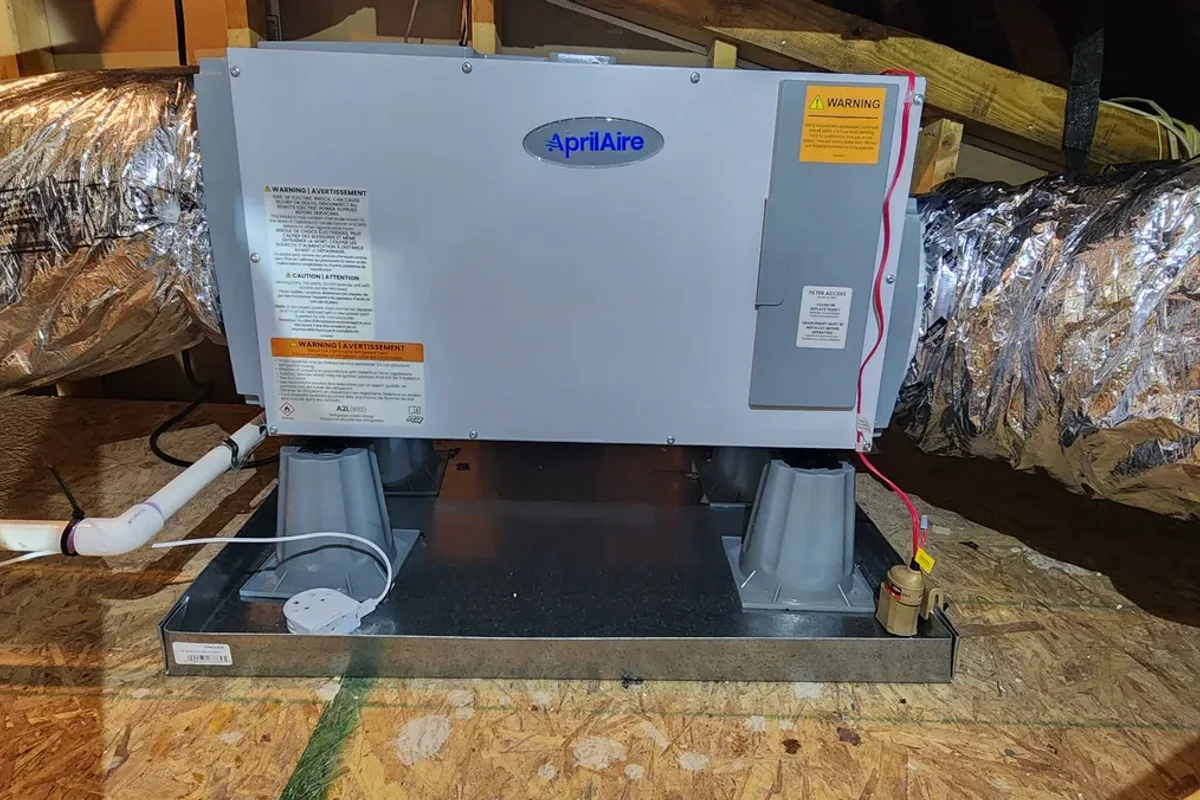
That’s where we come in. Triangle Dehumidifiers, LLC installs AprilAire whole-house dehumidifiers at the air handler, ducted so the dry air distributes through your existing supply system. It runs on its own humidity setpoint, completely independent of the thermostat, which is exactly what makes it work on those rainy 75°F days when the AC barely runs. It does add a small amount of heat to the air, which the air conditioner then removes; the Building America Solution Center notes that this makes the AC “run a little bit longer, which will dehumidify the air even more.” Installed cost runs an estimated $4,500–$5,500 for a standard air handler integration, or $5,000–$7,000 when the HVAC setup needs additional ductwork or electrical. Our walkthrough of what a whole-house dehumidifier installation involves covers the day itself.
One caution: if the crawl space is the real moisture source, a whole-house unit alone is treating the symptom. Vented crawl spaces in the Triangle run 70–85% RH in summer, and that air moves up into the living space. A crawl space dehumidifier, which is the other half of what we install, handles that at the source, and some homes need both.
Frequently Asked Questions
Does an air conditioner remove humidity?
Yes, as a byproduct of cooling. Water vapor condenses on the cold indoor coil, but it has to actually drain away to count as moisture removed from the house. One laboratory study found that took roughly 12 to 33 minutes at typical conditions, though the exact figure varies by equipment. A system that short-cycles, runs too much airflow, or keeps the blower running after the compressor stops can end up removing far less net moisture than its rating suggests.
How long does an AC need to run to remove humidity?
Long enough for condensate to actually drain, not just condense, and then some. In one laboratory study, the Florida Solar Energy Center found condensate first drained from the coil roughly 12 to 33 minutes into a cycle, and one residential system provided no net moisture removal when the compressor ran less than about 40% of the time with the fan running continuously. That's one study, not a universal rule, but it points to the same general pattern: longer cycles, several times an hour on humid days, tend to dehumidify a house more effectively than a string of short ones.
Is 70% humidity in a house too high?
Yes. At 75°F, 70% RH means an indoor dew point near 65°F, which is high enough for condensation on supply registers and other cold surfaces and for mold to grow on dust and drywall paper. The EPA recommends keeping indoor humidity below 60%, ideally 30–50%. Triangle Dehumidifiers targets 45–50% RH in Triangle homes.
Should the AC fan be set to ON or AUTO?
AUTO is generally recommended if humidity is a concern. With the fan ON, air keeps moving across the wet coil after the compressor stops and can re-evaporate some condensate back into the supply air. One documented case showed indoor RH rising from about 58% to 70% with the fan set to ON. Fan-off delays and enhanced blower profiles that run the fan briefly after cooling ends can have a similar effect, though the right setting depends on the equipment; a technician can confirm what's manufacturer-approved for your system.
Will a two-stage or variable-speed air conditioner fix humidity?
It can, if it is sized from a Manual J load calculation, paired with a variable-speed air handler, wired so the thermostat can call for dehumidification, and set up with a humidity setpoint, reduced dehumidification airflow, and a short or zero fan-off delay. Installed with a basic thermostat and factory default settings, staged equipment dehumidifies about like a single-stage unit.
Can a whole-house dehumidifier fix humidity without replacing my AC?
Yes. A whole-house dehumidifier installed at the air handler runs on its own humidity setpoint and removes moisture whether or not the air conditioner is running. For a working single-stage system that isn't due for replacement, it is usually the most practical fix. In the Raleigh area the installed cost is typically $4,500–$5,500 for a standard integration, or $5,000–$7,000 for a more complex one.
Cooling Fine, Still Humid? Start With a Measurement.
The difference between a setup problem and a moisture problem shows up in about twenty minutes with a hygrometer, a thermometer at the supply register, and a look at how the system is wired and programmed. Triangle Dehumidifiers, LLC in Holly Springs, NC provides free in-home humidity evaluations throughout Wake County and the Triangle. We’ll measure indoor RH and dew point, check how your air conditioner is set up for humidity, and tell you whether the fix is a settings change, a whole-house dehumidifier, a crawl space dehumidifier, or nothing at all.
Call or text us at (919) 867-0580, or request your free evaluation online. We serve Raleigh, Cary, Apex, Holly Springs, Fuquay-Varina, Garner, Wake Forest, Knightdale, Morrisville, Durham, and Chapel Hill.