Table of Contents
When a Damp Crawl Space Starts Rotting the Wood Above It
By August, a vented crawl space in the Triangle has been sitting in elevated humidity for months. Floor joists and subfloor exposed to that air don’t just feel damp. Past a certain point, sustained moisture lets decay fungi take hold in the wood itself, and crawl space wood rot moves from a moisture problem to a structural one.
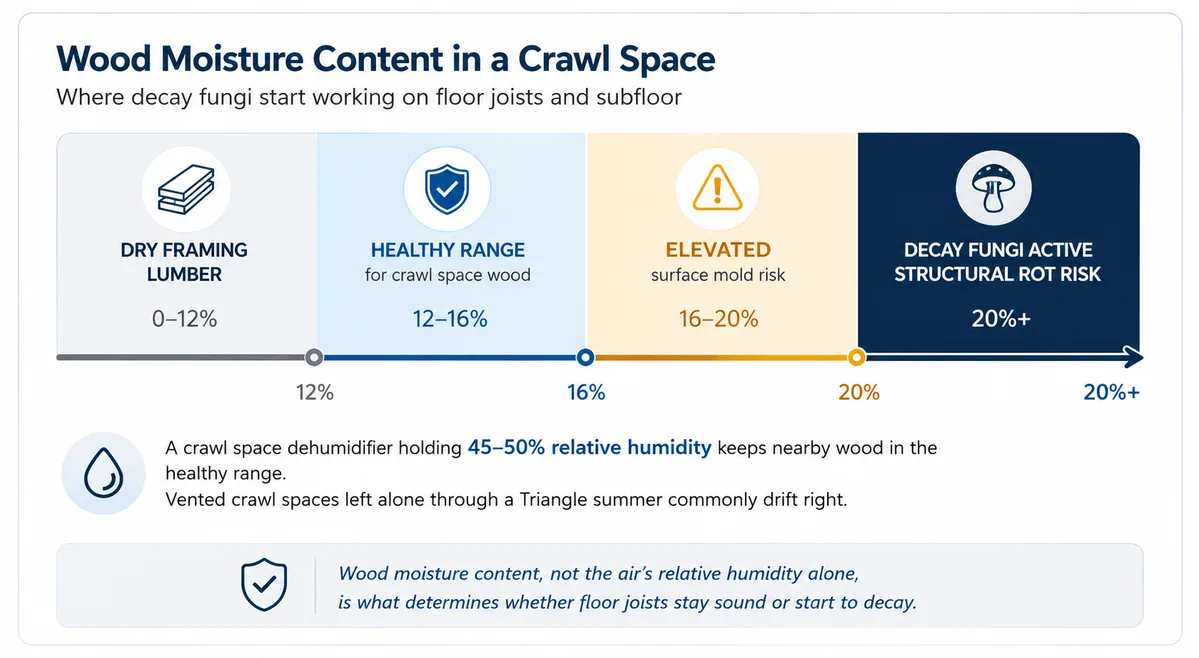
Keeping wood moisture content below roughly 20% is the standard prevention guideline from the USDA Forest Products Laboratory. Decay fungi are generally inhibited below that level, but crossing it isn’t an on/off switch for rot. Active decay depends on sustained moisture, warm temperatures, oxygen, and fungal exposure over time, and it’s more commonly associated with wood nearer fiber saturation, roughly the mid-20s to 30% moisture content. Either way, the longer a floor joist stays wet, the closer it moves toward that territory.
Wood Rot Is a Different Problem Than Surface Mold
Surface mold on a floor joist may not mean the wood has lost structural strength, but it signals an active moisture problem and can affect indoor air quality, particularly for people with asthma, allergies, chronic lung disease, or a weakened immune system. It tends to show up once relative humidity in the crawl space holds above roughly 60% for an extended stretch. The right cleanup approach depends on how much mold is present, where it is, the condition of the material underneath, and whether the moisture source has actually been corrected, not a one-size-fits-all wipe-down.
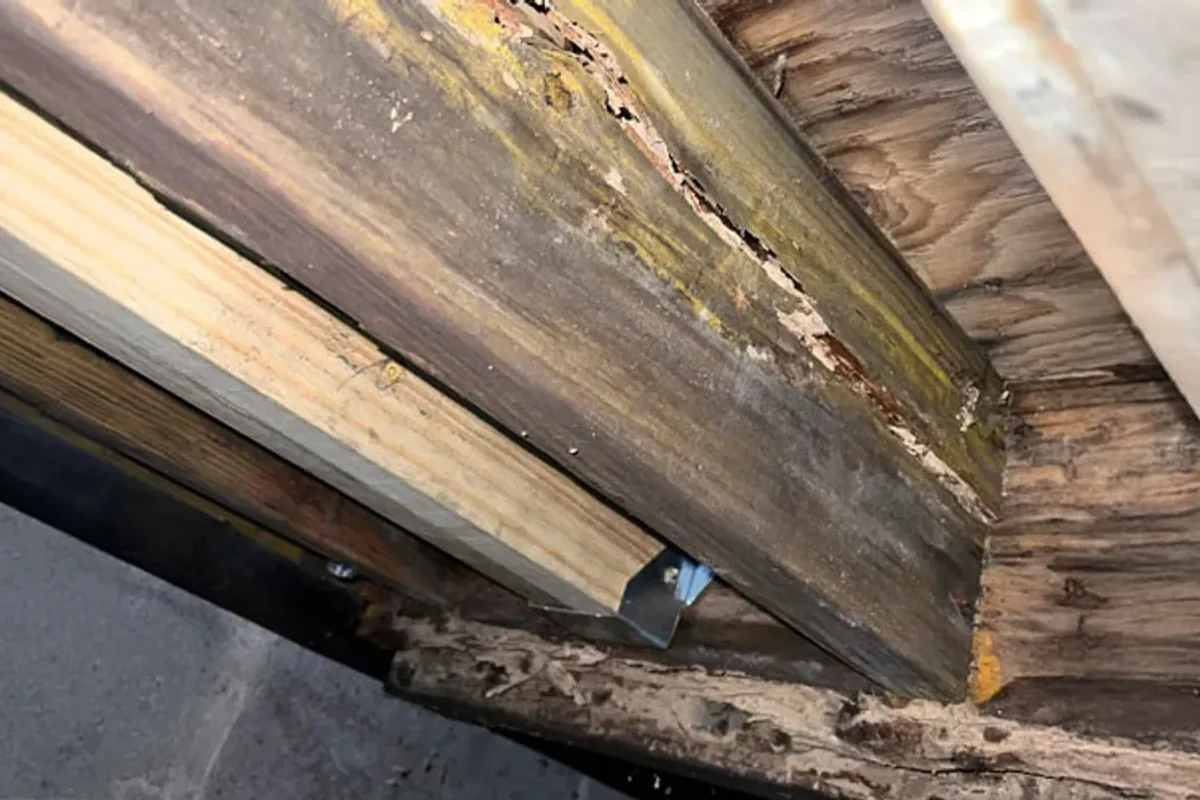
Wood rot works differently. Decay fungi don’t stay on the surface. They break down the cellulose and lignin inside the wood, and a joist that’s been rotting for months can lose real load-bearing strength before anyone notices a soft spot in the floor above it. A crawl space can have both problems at once, or either one on its own. Crawl Space Mold Health Risks covers the surface mold side in more detail. This post is about what happens once the wood itself starts breaking down.
Why Vented Crawl Spaces Get There by Late Summer
Many Triangle homes have clay-rich soils and drainage conditions that can keep the soil beneath a crawl space damp, especially after repeated summer rain. A vented crawl space pulls in whatever the outside air is doing, and from May through September that typically means 70–90% relative humidity. When that humid outdoor air enters a cooler crawl space and reaches its dew point on cooler surfaces, condensation can form, especially on ductwork, pipes, masonry, or framing near moisture sources, and in a space with open vents and exposed soil, that moisture has fewer ways to leave than it does to arrive.
Floor joists and subfloor sit in that air all summer. Why Crawl Spaces Stay Wet All Summer in the Triangle walks through the stack effect and soil moisture mechanics in more detail. Wood that started the season at a healthy 12–16% moisture content in a vented Triangle crawl space has months of exposure to work with by the time August arrives, and the more time it spends in that condensation-prone range, the further its own moisture content can climb.
Signs of Wood Rot Worth Checking For
The following point to a moisture problem or possible framing damage, not to confirmed wood rot on their own:
- A section of subfloor that feels soft or springy underfoot, especially near an exterior wall or bathroom
- Floor joists that look darker, stained, or slightly swollen where you can see them from the crawl space access
- A musty smell that’s noticeably stronger in one part of the house
- Doors or windows on that side of the house that have started sticking
Stronger indicators that decay may already be present usually take a trained eye to confirm: cubical cracking in the wood grain, wood that crumbles or feels soft when probed by a qualified inspector, visible loss of wood section, fungal fruiting bodies on framing, and floor deflection or visible sagging when you sight down a hallway.
None of the signs in the first group alone means the wood is structurally compromised, and probing suspect framing yourself isn’t a good idea. It can miss what’s actually going on inside the wood and, if the section has already lost integrity, create a safety issue. If you’re seeing several of these signs, especially together, it’s worth having Triangle Dehumidifiers or a qualified inspector take a look before another season goes by.
What Triangle Dehumidifiers Does About It
Before sizing a dehumidifier, any bulk-water sources feeding the crawl space, plumbing leaks, exterior drainage problems, standing water, or groundwater intrusion, need to be corrected first. A dehumidifier controls airborne moisture. It isn’t a substitute for fixing active water entry.
With that squared away, Triangle Dehumidifiers, LLC installs crawl space dehumidifiers sized to hold a crawl space at 45–50% relative humidity, well clear of the sustained high-humidity conditions that put wood at risk. For a crawl space that starts out vented, we convert it into a closed, partially sealed moisture-control system: foundation vents sealed, the exposed ground covered with a vapor barrier, and an AprilAire E100W or E130W installed and sized for the higher moisture load, with an installed cost estimated at $3,000–$5,000. In a crawl space that’s already encapsulated, an E70W, E80W, or E100W is often enough, running an estimated $3,000–$4,000.
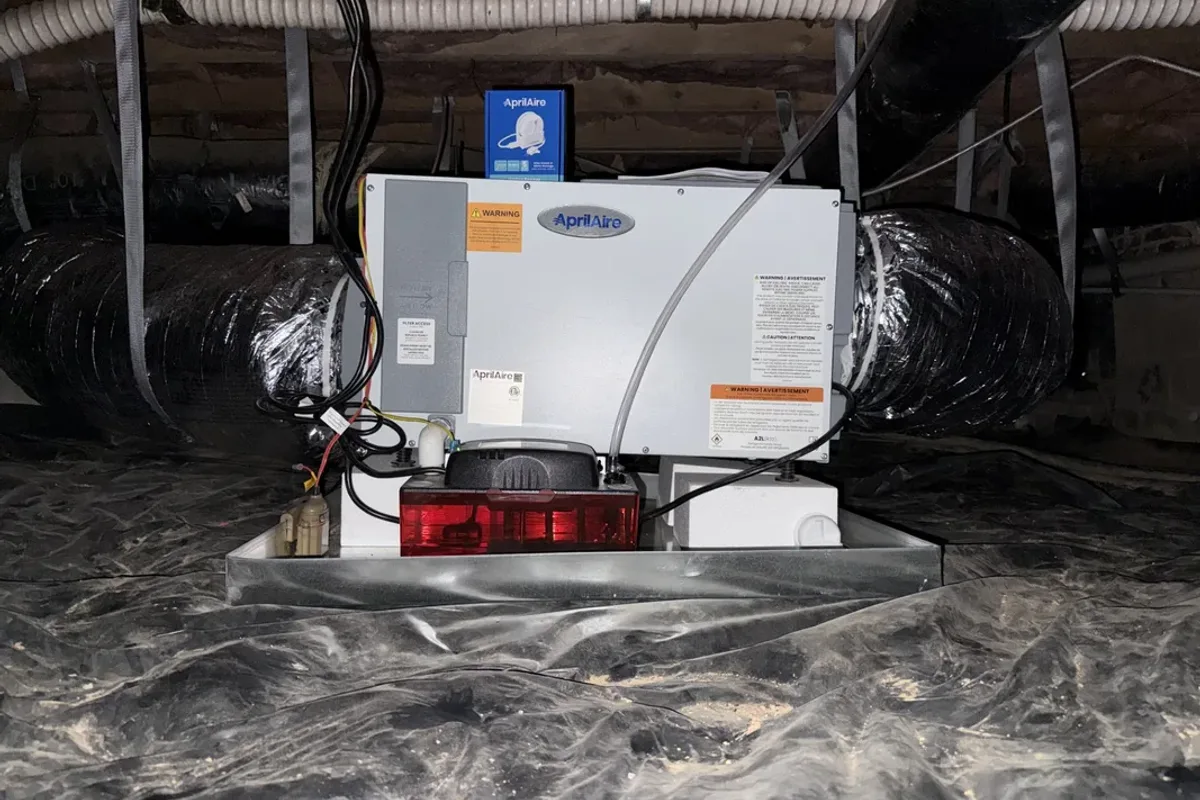
That said, a dehumidifier with a vapor barrier or full encapsulation cannot repair wood that’s already structurally compromised. If framing looks or feels soft, spongy, or visibly deteriorated, that’s a signal for evaluation by a qualified structural repair contractor, licensed contractor, or structural engineer, not something to test by hand. A free crawl space inspection from Triangle Dehumidifiers will tell you whether you’re looking at early-stage moisture damage a dehumidifier can stop, or something further along that needs a repair estimate first.
Structural repair itself isn’t part of a dehumidifier or encapsulation install. If a joist or section of subfloor needs to be sistered, replaced, or otherwise repaired, that work is evaluated and quoted separately by a qualified structural repair contractor or engineer. Installing moisture control stops the conditions that caused the damage. It doesn’t include fixing damage that’s already there.
Frequently Asked Questions
At what humidity level does crawl space wood rot start?
Wood rot isn't driven directly by the relative humidity reading on a hygrometer. It's driven by how much moisture the wood itself absorbs, and that depends on temperature, airflow, wood species, and how the wood is getting wet, not just the ambient RH number. Decay fungi are generally inhibited below about 20% wood moisture content, and the conditions that favor active decay are more commonly associated with wood nearer fiber saturation, roughly the mid-20s to 30% range. Sustained high humidity in a crawl space is a warning sign, especially with direct wetting from condensation, standing water, or contact with damp soil, but a wood moisture meter and an in-person inspection are what actually confirm where a given joist stands, not a fixed humidity-to-moisture-content formula.
Is crawl space wood rot the same as mold?
No. Surface mold grows on the outside of a floor joist. It may not mean the wood has lost structural strength, but it signals an active moisture problem and can affect indoor air quality, especially for people with asthma, allergies, chronic lung disease, or a weakened immune system. Wood rot is caused by decay fungi that break down the wood's internal structure, which can affect how much weight a joist can safely carry. A crawl space can have one, both, or neither depending on how long it's stayed damp.
Can a dehumidifier fix a floor joist that's already rotting?
A dehumidifier stops the moisture that's feeding the decay process, but it doesn't reverse damage that's already happened. If framing looks or feels soft, spongy, or visibly deteriorated, that's a signal for evaluation by a qualified structural repair contractor, licensed contractor, or structural engineer, not something to test yourself. A dehumidifier or encapsulation is what keeps the rest of the crawl space from reaching that point.
How much does it cost to install a crawl space dehumidifier to prevent wood rot?
In a vented Triangle crawl space, installing a dehumidifier typically runs an estimated $3,000–$5,000, and closing the foundation vents is part of that work. In a crawl space that's already encapsulated, the cost is usually lower, an estimated $3,000–$4,000, since the moisture load is smaller. Triangle Dehumidifiers, LLC provides a free on-site inspection to confirm sizing before quoting a price.
Get an Inspection Before Wood Damage Sets In
If your crawl space has been sitting at high humidity all summer, the floor joists have been absorbing that moisture the whole time. Triangle Dehumidifiers provides free crawl space inspections throughout Wake County and the Triangle, checking actual humidity levels and crawl space conditions before recommending a fix.
Call or text us at (919) 867-0580, or request your inspection online. We serve Raleigh, Cary, Apex, Holly Springs, Fuquay-Varina, Garner, Wake Forest, Knightdale, Morrisville, Durham, and Chapel Hill.