Table of Contents
What Happens During a Crawl Space Dehumidifier Installation
By mid-June in the Triangle, most vented crawl spaces are running 75–85% relative humidity. If you’ve decided a dehumidifier is the right fix, the next question is usually: what does the installation actually involve, and what will my crawl space look like when it’s done?
A professional crawl space dehumidifier installation from Triangle Dehumidifiers, LLC typically takes 2–4 hours and leaves the crawl space targeting 45–55% RH within the first day of operation.
The Inspection Comes First
Triangle Dehumidifiers starts every job with a crawl space inspection. It’s not a formality. The inspection determines which unit gets installed and what the scope of work actually is.
During the inspection, the technician measures the crawl space square footage, reads current relative humidity with a calibrated meter, notes the crawl space height and access conditions, determines whether the space is vented or encapsulated, and locates the electrical outlet. In most Wake County homes, the crawl space is vented, meaning foundation vents are open to the outside, which affects both unit sizing and the work that gets done on installation day.
If the crawl space has standing water, significant drainage problems, or visible mold on floor joists, the technician identifies that during the inspection and discusses next steps before any equipment is ordered.
Which AprilAire Unit Gets Installed
Sizing is decided at the inspection, not after. Triangle Dehumidifiers, LLC installs AprilAire WiFi-enabled dehumidifiers, the E80W, E100W, and E130W, and the right choice depends on crawl space square footage, moisture load, and whether the space is vented or sealed.
For a sealed, encapsulated crawl space up to about 1,500 square feet, an AprilAire E80W (80-pint-per-day capacity) is typically correct. For a vented crawl space of the same size, or a larger encapsulated space, the E100W is more common. The E130W handles larger vented crawl spaces or spaces with high moisture loads, covering homes up to 7,200 square feet. For a full breakdown of how sizing works, see the crawl space dehumidifier sizing guide.
What the Installation Looks Like, Step by Step
Once the unit is sized and the inspection is complete, installation follows a consistent sequence.
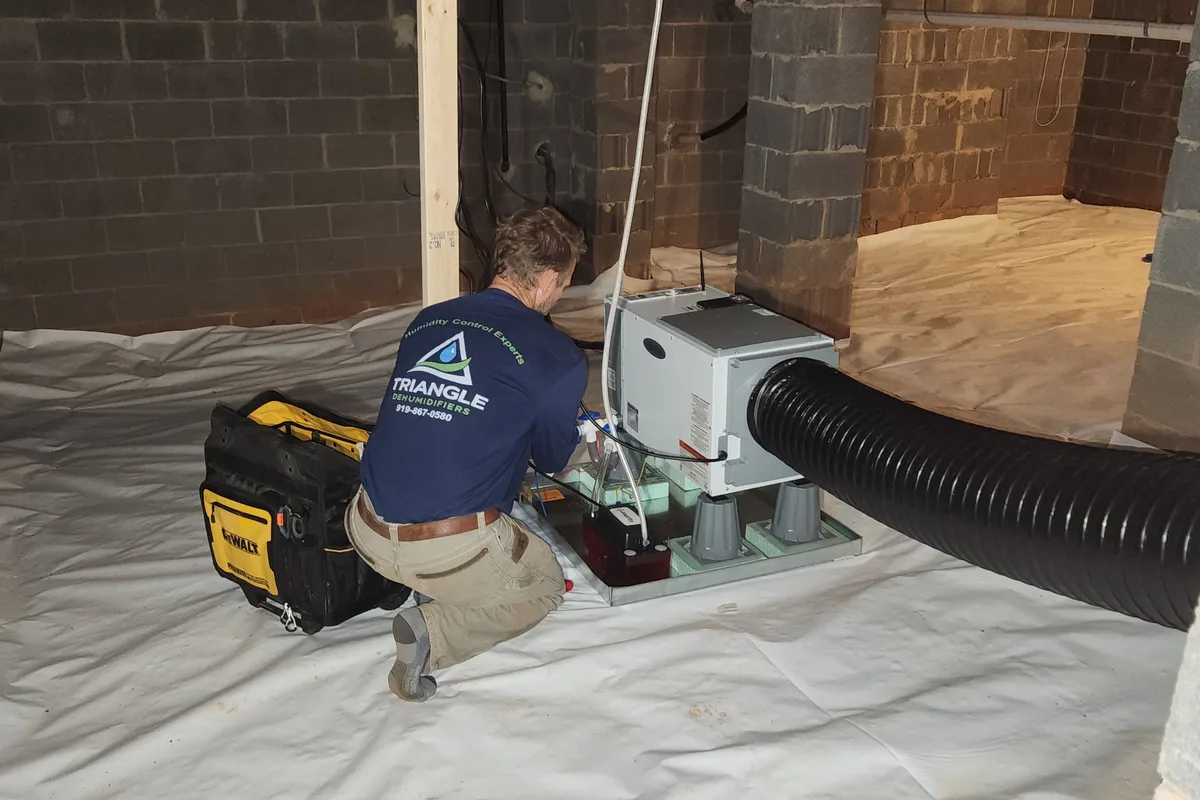
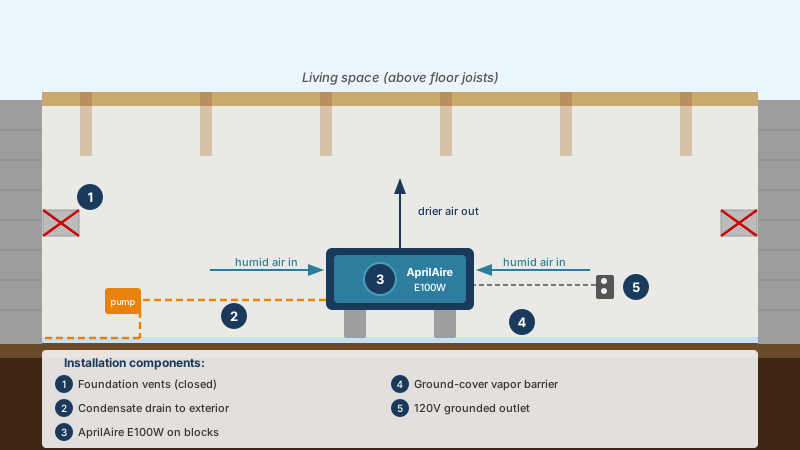
Positioning the unit on support blocks. The dehumidifier is placed on support blocks to keep it off the crawl space floor. This protects the unit from occasional standing water and allows air to circulate underneath. The ideal position is near the center of the crawl space for even air distribution, though access constraints sometimes require adjusting.
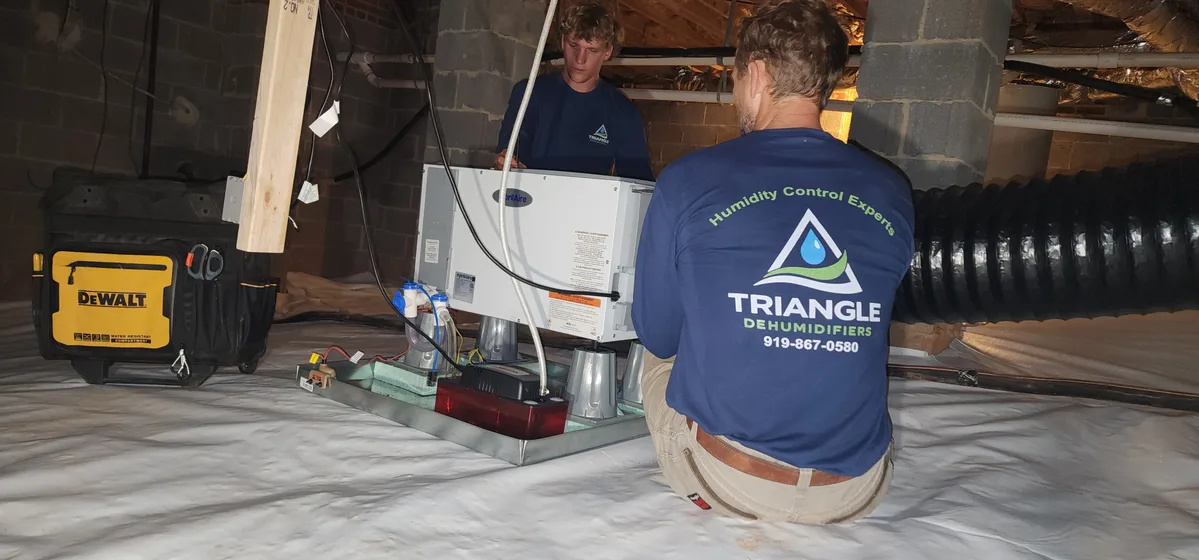
Running the condensate drain line. The dehumidifier pulls water out of the air and needs somewhere to send it. The technician runs a condensate drain line to the nearest floor drain, sump pit, or exterior wall penetration. If gravity drainage isn’t possible, which is common in crawl spaces that slope away from a drain point, a small condensate pump is added. The pump pushes water up and out through a wall penetration. It’s included in the installed price.
Electrical connection. AprilAire crawl space units need a standard 120V, 15-amp grounded outlet within reach of the unit. Most Triangle crawl spaces already have one near the access door from a prior inspection light or sump pump installation. If there’s no outlet, you’ll need an electrician to add one before installation day. This is caught at the inspection, not discovered on the day of the job.
Closing foundation vents (vented crawl spaces). Leaving foundation vents open in a vented crawl space defeats the purpose of the dehumidifier. During a Triangle summer, outdoor air at 80–90% RH flows directly into the crawl space through open vents, and the dehumidifier ends up fighting an unlimited supply of outdoor moisture. Triangle Dehumidifiers closes the foundation vents as part of the installation using foam vent covers installed from the inside. A 100% ground-cover vapor barrier is installed at the same time. Covering the ground and closing the vents is the baseline for every dehumidifier installation, encapsulated or not. Triangle Dehumidifiers never installs a unit on bare dirt with vents open to the outside.
WiFi setup and first test run. Once the unit is in place, the technician powers it on, connects it to the AprilAire Healthy Air app via WiFi, sets the target humidity (typically 50% RH for a Triangle crawl space), and confirms the unit is running and draining correctly. Most crawl spaces see humidity begin dropping within the first few hours.
Vented vs. Encapsulated: How It Changes the Scope
Both paths are standard for Triangle Dehumidifiers. The installation just looks a little different.
In an encapsulated crawl space (100% ground-cover vapor barrier, foundation walls insulated with foil-faced foam board or wrapped with heavy liner, and vents permanently sealed), the moisture load is much lower. An AprilAire E80W typically handles most encapsulated spaces up to about 1,500 square feet. The dehumidifier scope here is mainly unit placement, condensate drain, and outlet connection, because the sealing and wall insulation are part of the encapsulation project.
In a vented crawl space (the default in most Wake County homes built before 2010), the unit works harder because outdoor air and wall moisture still reach the space even after the vents are closed. Triangle Dehumidifiers closes the foundation vents and installs a 100% ground-cover vapor barrier, but some air still leaks through the vents and crawl space door, and uncovered walls continue to allow moisture through. Because the moisture load is higher than in a fully encapsulated space, the unit is usually larger (E100W or E130W), and the installation scope is wider, which is why the cost range is slightly broader. For a detailed look at this path, see installing a crawl space dehumidifier without encapsulation.
Encapsulation doesn’t need to happen first, but it does affect what gets installed and how.
What It Costs
A professionally installed crawl space dehumidifier in the Triangle runs an estimated $3,000–$4,000 in an encapsulated crawl space and $3,000–$5,000 in a vented crawl space, depending on crawl space size, access conditions, and whether a condensate pump is needed. The wider range for vented spaces reflects the vent-closing and vapor barrier work that’s often part of the job.
For a full breakdown of what drives the cost (unit model, crawl space size, drainage complexity), see crawl space dehumidifier cost in Raleigh, NC.
Frequently Asked Questions
How long does a crawl space dehumidifier installation take?
Most installations take 2–4 hours from start to finish. A straightforward job in an accessible, already-encapsulated crawl space runs closer to 2 hours. A vented crawl space where vents need to be closed, a vapor barrier added, and a condensate pump line run to the exterior can take 3–4 hours.
Do I need to encapsulate my crawl space before installing a dehumidifier?
No. Triangle Dehumidifiers, LLC installs dehumidifiers in vented crawl spaces regularly. Encapsulation is not a prerequisite. Every installation includes 100% ground vapor barrier coverage and closed foundation vents as the baseline, whether or not the walls are encapsulated. The unit required is typically larger (an AprilAire E100W or E130W rather than an E80W). Encapsulation can be added later if you want a more complete moisture control system.
What electrical setup does a crawl space dehumidifier require?
AprilAire crawl space dehumidifiers need a standard 120V, 15-amp grounded outlet within reach of the unit. Most Triangle crawl spaces already have an outlet near the access door. If there is no outlet, an electrician visit is required before installation can proceed. Triangle Dehumidifiers identifies this during the inspection, not on installation day.
Where does the water go after the dehumidifier pulls it from the air?
Through a condensate drain line. In most Triangle crawl spaces, the line runs to a floor drain, sump pit, or exterior wall penetration. If gravity drainage isn't possible, a small condensate pump is added as part of the installation, at no separate charge.
Ready to Stop Guessing? Get an Inspection and an Exact Quote.
By mid-summer, crawl spaces across Wake County are holding the highest moisture levels of the year. If you’ve been putting off the decision, now is a practical time to have someone come out and measure what’s actually happening before July and August push it higher.
Triangle Dehumidifiers, LLC provides crawl space inspections throughout Wake County and the Triangle. We’ll measure your crawl space, check current humidity levels, and give you a written quote. No upsells, no scare tactics.
Call or text us at (919) 867-0580, or request an inspection online. We serve Raleigh, Cary, Apex, Holly Springs, Fuquay-Varina, Garner, Wake Forest, Knightdale, Morrisville, Durham, and Chapel Hill.