Table of Contents
Who Installs Whole-House Dehumidifiers in the Triangle
As late-summer humidity continues across Wake County, a lot of homeowners are still noticing sticky air indoors even with the AC running, and they start looking for who actually installs a whole-house dehumidifier and how to tell a solid installer from someone who just bolts a box onto the ductwork. The short answer: HVAC contractors and moisture control specialists both do this work, but the equipment involves electrical wiring, a condensate drain line, and a tie-in to your existing duct system, so it’s not a general handyman job.
Triangle Dehumidifiers, LLC installs whole-house dehumidifiers integrated directly into the HVAC system for homes across Wake County and the Triangle. The rest of this guide covers what the installer actually does, what separates a good one from a mediocre one, and what the job costs.
What a Whole-House Dehumidifier Installer Actually Does
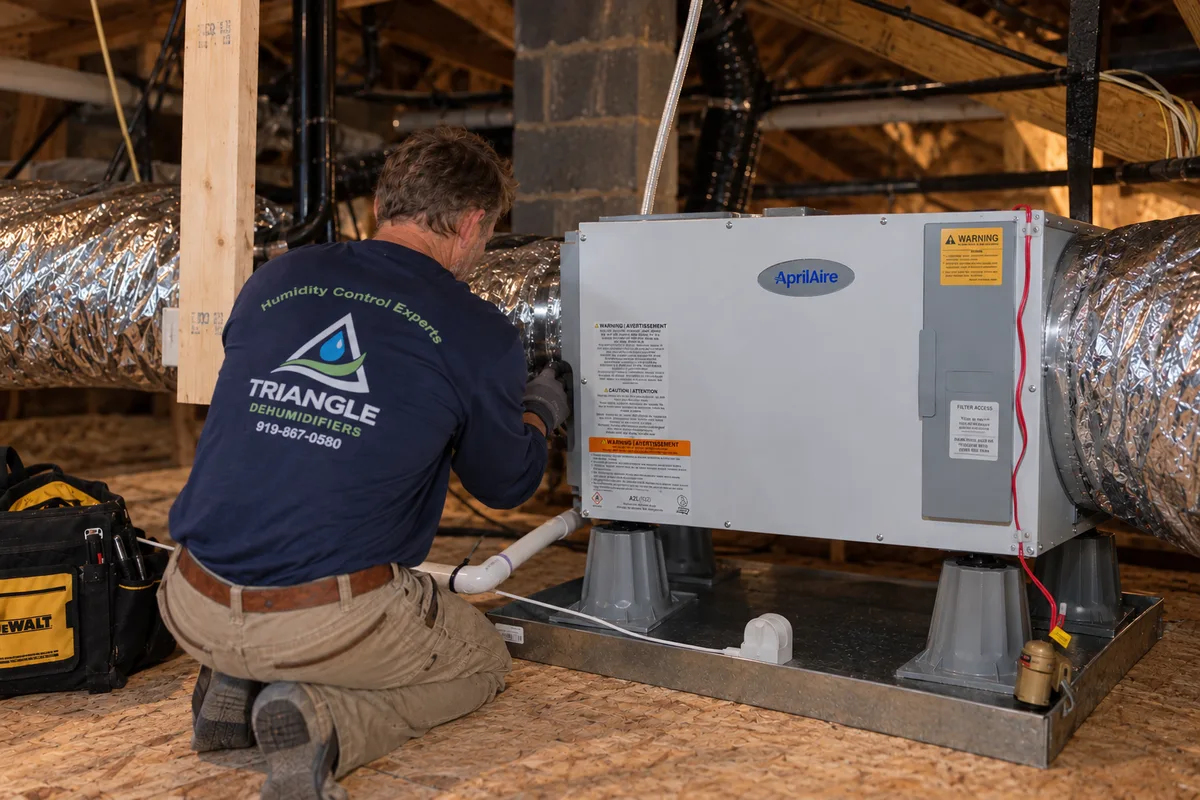
A whole-house dehumidifier connects to your existing ductwork near the air handler, using a manufacturer-approved duct layout. The installer runs a condensate line to a drain or pump and installs the required controls.
The unit needs an appropriate 120V electrical connection. Depending on the model, existing electrical setup, and local code, that may require electrical work. That means the person doing the work needs to be comfortable with both HVAC ductwork and basic electrical connections, not just one or the other.
How a Whole-House Dehumidifier Ties Into Your HVAC System
A whole-house dehumidifier uses its own fan and refrigerant coil to remove moisture from air moving through the unit. It is installed near the air handler and connected to the HVAC system using a manufacturer-approved duct layout. Depending on the model and existing ductwork, that may involve return-to-return ducting, return-to-supply ducting, or dedicated duct connections. It also runs on its own humidity set point, independent of the thermostat, so it keeps pulling moisture out even on a mild day when the AC barely runs.
The diagram below shows one example configuration, a return-to-supply layout, not the only way a unit can be installed.
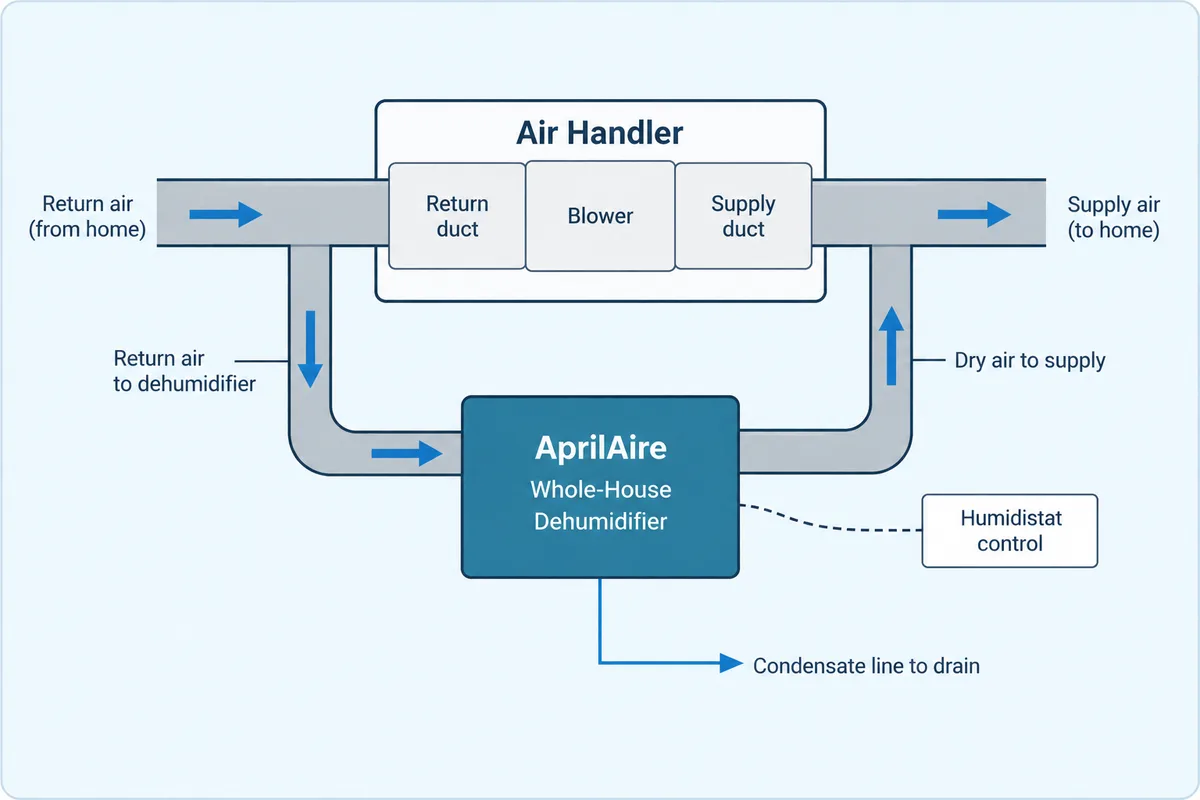
Because the unit ties into your HVAC ductwork, an installer who doesn’t account for existing duct static pressure can end up with a system that runs but underperforms. This is one of the reasons sizing and placement matter more than brand name.
HVAC Contractor or Moisture Control Specialist: Who to Call
General HVAC contractors install furnaces, AC systems, and heat pumps every day, and many of them can add a whole-house dehumidifier competently. The gap shows up in diagnosis. A contractor focused mainly on heating and cooling may recommend a dehumidifier based on square footage alone, without measuring your home’s actual relative humidity or figuring out where the moisture is coming from.
A moisture control specialist starts from the humidity problem itself. Triangle Dehumidifiers, LLC measures indoor RH before recommending equipment, and sizes the unit to the actual load rather than a rule of thumb. Neither approach is wrong, but the second one tends to avoid an undersized unit that runs constantly without bringing humidity down.
Questions to Ask Before You Hire an Installer
- Do you measure indoor relative humidity before recommending a unit, or size by square footage alone?
- Which brand and model do you install, and what’s its rated capacity in pints per day?
- Will the unit tie into a dedicated humidistat, or share control with the thermostat?
- Where does the condensate line drain, and does it need a pump?
- Does this installation require a mechanical or electrical permit where I live, who pulls it, and who performs any electrical work?
- What’s the warranty on parts and labor, and who do I call if the unit stops removing moisture?
A contractor who answers these without hesitation has likely done this enough times to get it right the first time.
What It Costs to Have a Whole-House Dehumidifier Installed
A whole-house dehumidifier with standard HVAC integration typically runs an estimated $4,500–$5,500 in the Triangle, covering the unit, ductwork tie-in, condensate line, and controls. Older HVAC systems, tight mechanical closets, or additional electrical work can push that to an estimated $5,000–$7,000. Get a written quote that breaks out the unit cost from labor, so you know what you’re paying for each part of the job.
Keeping indoor relative humidity below 60%, and ideally between 30–50%, is the range the U.S. EPA recommends to limit mold and dust mite growth. A properly sized whole-house dehumidifier is one way to hold that range through a Triangle summer without running the AC colder than you’d like.
Frequently Asked Questions
Can I install a whole-house dehumidifier myself?
Most homeowners don't. A whole-house dehumidifier connects to your HVAC ductwork using a manufacturer-approved layout, needs a dedicated condensate drain line, and needs an appropriate 120V electrical connection and a control wired to the thermostat or a standalone humidistat. That's electrical and HVAC work, and getting the duct connections wrong affects airflow through the whole system.
Do all HVAC companies install whole-house dehumidifiers?
Some do, but not all HVAC contractors work with whole-house dehumidifiers regularly. Ask directly how many they've installed, which brand and model they use, and whether they size the unit based on your home's actual humidity load or just default to one size. A company that installs AC and furnace systems all day isn't automatically experienced with dehumidification.
How long does whole-house dehumidifier installation take?
A standard installation on an accessible HVAC system typically takes about a day. Older systems, tight mechanical closets, or duct modifications can push that to two days. Ask your installer for a specific timeline before work starts.
Does a whole-house dehumidifier replace a crawl space dehumidifier?
No. A whole-house dehumidifier treats the air moving through your HVAC system, which is your living space. It doesn't reach a crawl space that isn't connected to your ductwork. Homes with both a humid crawl space and muggy living areas often need a dehumidifier in each location.
Get a Straight Answer on What Your Home Needs
If your living space still feels muggy after the AC runs, or you’re comparing quotes and not sure what separates a good whole-house dehumidifier install from a rushed one, a free inspection is the fastest way to get a real answer. Triangle Dehumidifiers, LLC measures your home’s actual humidity before recommending anything, and every quote breaks out the unit, ductwork, and controls so you know what you’re paying for.
Call or text us at (919) 867-0580, or request your free inspection online. We serve Raleigh, Cary, Apex, Holly Springs, Fuquay-Varina, Garner, Wake Forest, Knightdale, Morrisville, Durham, and Chapel Hill. Curious what the install itself looks like day-of? See what to expect during a whole-house dehumidifier installation.